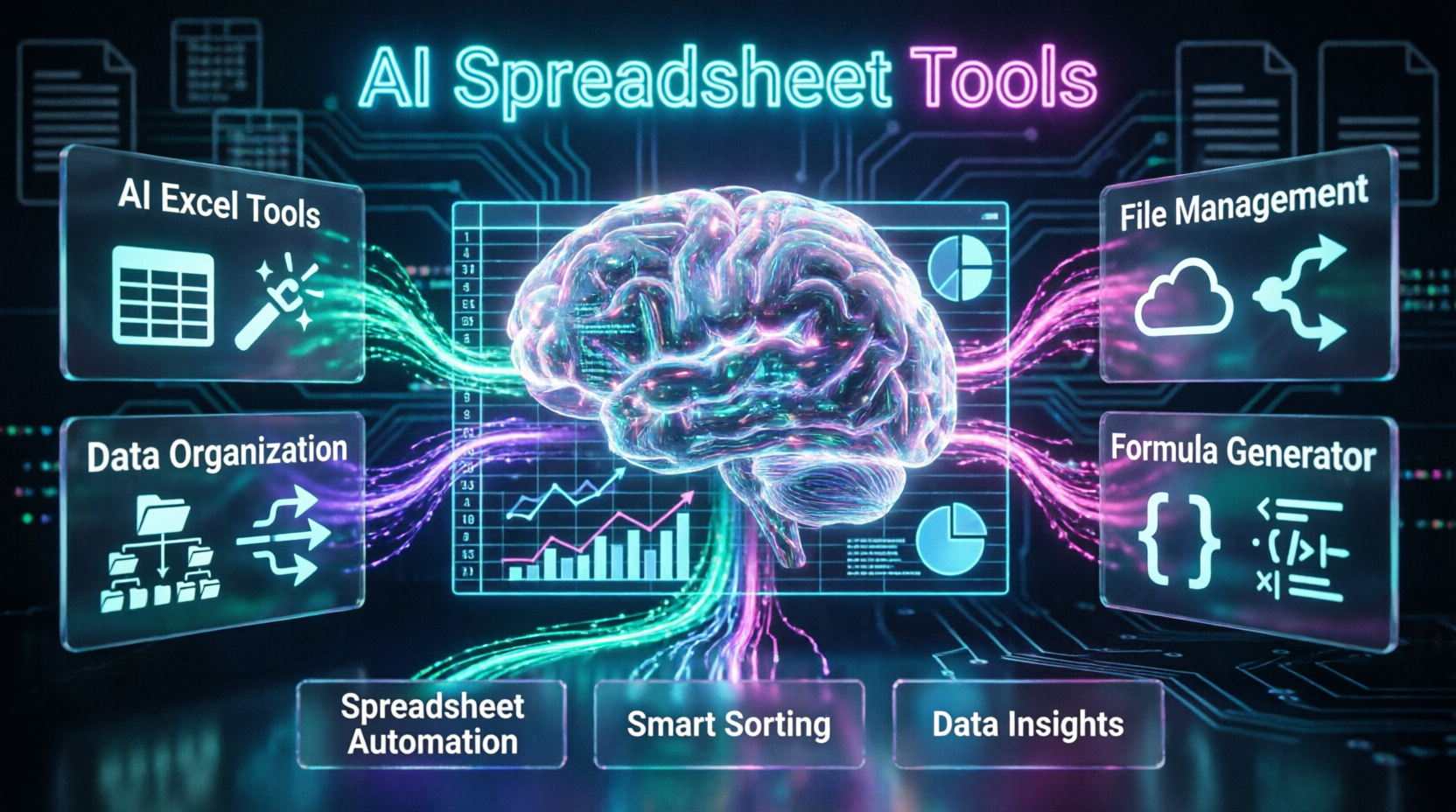
Mastering the deployment of AI spreadsheet tools has become the definitive competitive advantage for modern data analysts, finance professionals, and operations teams looking to eliminate manual data entry and unlock deeper insights. In an era where organizations generate terabytes of unstructured and structured data daily, relying on manual formulas, copy-pasting, and fragmented file systems is no longer a viable strategy for operational efficiency. Today, forward-thinking enterprises are leveraging advanced natural language processing, machine learning, and intelligent automation to transform how they organize, analyze, and manage their data. If you are looking to understand exactly how to integrate these technologies into your daily workflow to save hours and reduce errors, you are in the right place.
This comprehensive guide demystifies the landscape of intelligent data management. We will explore the top AI Excel tools and AI formula generator platforms, detail the capabilities of modern AI data organization tools, and provide a strategic blueprint for implementing AI file management software. By the end of this article, you will have a clear, actionable framework for utilizing spreadsheet automation AI, optimizing your data workflows, and driving measurable productivity gains through intelligent data handling.
1. The Data Efficiency Imperative: Why AI Spreadsheet Tools Matter in 2026
Historically, spreadsheet management was a purely manual, highly reactive process. Knowledge workers spent up to 30% of their week manually entering data, debugging broken VLOOKUPs, deduplicating rows, and searching through disorganized network drives for the “final_final_v3.xlsx” file. While this approach might have been manageable for small datasets, the modern volume of business data has created a severe bottleneck, leading to costly human errors and decision paralysis.
The integration of AI spreadsheet tools represents a quantum leap in data productivity. Unlike legacy software that merely provides a static grid for manual input, modern AI-driven platforms actively understand the context, structure, and intent of your data. They can automatically clean messy datasets, generate complex formulas from plain English, and intelligently route files to the correct repositories. According to recent research by Gartner, organizations that fully embrace spreadsheet automation AI report a 40-50% reduction in time spent on data preparation and a significant decrease in operational errors, allowing teams to focus on strategic analysis rather than mundane data wrangling.
2. Mastering the Grid: Top AI Excel Tools and AI Formula Generators
The spreadsheet remains the universal language of business, but writing and debugging complex formulas is a major pain point. This is where AI Excel tools and specialized AI formula generator platforms shine, acting as an intelligent co-pilot for your data.
Natural Language to Formula Translation Modern AI formula generator tools (like Formula Bot, Sheet AI, or Microsoft Copilot for Excel) allow users to describe what they want to achieve in plain English. Instead of struggling to remember the syntax for a nested INDEX-MATCH or a complex regular expression, a user can simply type, “Calculate the year-over-year growth rate for column C, ignoring blank cells,” and the AI instantly generates the correct, optimized formula. This dramatically lowers the barrier to entry for advanced data analysis.
Automated Data Cleaning and Anomaly Detection Messy data is the enemy of accurate analysis. Advanced AI Excel tools can automatically scan a dataset to identify and flag anomalies, such as outlier values, inconsistent date formats, or duplicate entries. With a single click, the AI can suggest or automatically apply corrections, standardizing the data and ensuring the integrity of downstream reports and dashboards.
Dynamic Data Summarization and Insights Beyond formula generation, AI can automatically analyze a selected range of cells and generate plain-English summaries, pivot table suggestions, or trend forecasts. For example, an AI assistant can highlight a sales dataset and instantly produce a narrative summary: “Sales in Q3 increased by 15%, driven primarily by the EMEA region, though product X saw a 10% decline.”
3. Beyond the Cell: AI Data Organization Tools and Smart Tables
While traditional spreadsheets are powerful, they often struggle with relational data and collaboration. AI data organization tools bridge this gap by transforming flat spreadsheets into intelligent, relational databases that adapt to your workflow.
Intelligent Categorization and Tagging When importing large datasets, AI data organization tools can automatically analyze the content of each row and assign relevant tags, categories, or statuses. For instance, if you import a list of customer feedback, the AI can automatically categorize each entry as “Bug Report,” “Feature Request,” or “Praise” based on the text, eliminating hours of manual sorting.
Smart Tables and Relational Linking Platforms like Airtable AI, Notion AI, or Smartsheet leverage AI to suggest relationships between different tables. If you have a “Projects” table and a “Team Members” table, the AI can suggest linking them based on matching names or departments, creating a dynamic, interconnected database that is far more powerful than a static spreadsheet.
Automated Workflow Triggers AI data organization tools often include no-code automation builders. You can set up rules like, “If the ‘Status’ column changes to ‘Urgent’, automatically send a Slack notification to the project manager and create a high-priority task in Jira.” This turns passive data storage into an active, responsive workflow engine.
a strategic blueprint for selecting the right AI file management software. By the end of this article, you will have a clear, actionable framework for utilizing spreadsheet automation AI, optimizing your data workflows, and driving measurable productivity gains through intelligent data handling.
4. Taming the Chaos: AI File Management Software for Enterprises
Spreadsheets do not exist in a vacuum; they are part of a broader ecosystem of documents, reports, and data files. AI file management software is essential for ensuring that the right data is accessible, secure, and easily discoverable across the organization.
Semantic Search and Intelligent Discovery Traditional file management relies on exact filename matches or rigid folder structures, which often fail when users forget how a file was named. AI file management software utilizes semantic search, allowing users to find files by describing their content. A query like “Q3 financial projection spreadsheet from the marketing team” will instantly surface the correct document, even if the filename is “Fin_Proj_v4.xlsx”.
Automated Metadata Extraction and Routing When a new file is uploaded to a shared drive or cloud storage, AI can automatically scan its contents, extract key metadata (e.g., document type, author, date, key topics), and route it to the appropriate folder or compliance repository. This eliminates the need for manual filing and ensures that corporate knowledge bases remain organized and up-to-date.
Version Control and Duplicate Prevention One of the most frustrating aspects of file management is dealing with multiple conflicting versions of the same document. AI-powered systems can intelligently detect duplicate or near-duplicate files, suggest merging them, and maintain a clear, linear history of changes, ensuring that teams are always working from the single source of truth.
5. Implementing Spreadsheet Automation AI: A Strategic Framework
Adopting AI spreadsheet tools and AI file management software requires more than just purchasing licenses; it demands a strategic change management process to ensure adoption, maintain data security, and maximize ROI.
Step 1: Start with High-Friction, Repetitive Tasks Do not attempt to automate your most complex, bespoke financial models on day one. Start with high-volume, rule-based tasks. Ideal pilot programs include automated monthly report generation, bulk data cleaning for CRM imports, or using an AI formula generator to help non-technical staff build basic dashboards. These use cases offer clear, measurable time savings.
Step 2: Prioritize Data Security and Governance Spreadsheets often contain highly sensitive financial, HR, or customer data. When evaluating spreadsheet automation AI platforms, ensure the vendor is fully compliant with GDPR, CCPA, and SOC 2 standards. Crucially, verify that the provider offers a strict contractual guarantee that your proprietary data will not be used to train public, shared AI models. Data isolation is non-negotiable.
Step 3: Invest in User Training and Upskilling The best AI Excel tools are useless if your team does not know how to prompt them effectively. Provide comprehensive training on how to interact with the AI, how to verify its outputs, and how to integrate these tools into their existing daily routines. Encourage a culture of sharing successful prompts and automation templates across the team.
Step 4: Establish a Human-in-the-Loop (HITL) Verification Process AI is a powerful assistant, not an infallible oracle. Always implement a “human-in-the-loop” framework where AI-generated formulas, data categorizations, or file routings are spot-checked by a qualified human before being finalized or shared externally. This ensures accuracy and maintains trust in the new system.
6. Comprehensive Query Coverage
What are the best AI spreadsheet tools for small businesses? For small businesses, the best AI spreadsheet tools are those that offer high impact with low complexity. Platforms like Microsoft Copilot for Excel, SheetAI, or Airtable AI provide robust AI Excel tools and smart database features at accessible price points, allowing small teams to perform enterprise-level data analysis without dedicated data scientists.
How does an AI formula generator improve productivity? An AI formula generator improves productivity by eliminating the need to memorize complex syntax or spend hours debugging broken formulas. By translating plain English requests into accurate, optimized formulas instantly, it allows users to focus on analyzing the data rather than wrestling with the software.
Can AI file management software handle unstructured data? Yes. Modern AI file management software excels at handling unstructured data. Using natural language processing and optical character recognition (OCR), these systems can read the contents of PDFs, scanned documents, and messy text files, extracting meaningful metadata and making them searchable alongside structured spreadsheets.
Is spreadsheet automation AI secure for sensitive financial data? Yes, when implemented correctly. Reputable spreadsheet automation AI providers design their platforms specifically for enterprise use, adhering to strict security standards like SOC 2 Type II and ISO 27001. They offer end-to-end encryption and guarantee that your proprietary financial data remains isolated and is never used for public model training.
How do AI data organization tools prevent data silos? AI data organization tools prevent data silos by automatically linking related information across different tables and applications. By suggesting relationships and automating data syncing between your CRM, project management tool, and spreadsheets, they ensure that all teams are working from a unified, up-to-date source of truth.
Conclusion
Mastering AI spreadsheet tools is no longer a futuristic luxury; it is a present-day imperative for any organization striving to maintain a competitive edge in a data-driven world. By moving beyond manual, error-prone data entry and embracing the power of spreadsheet automation AI, AI data organization tools, and intelligent AI file management software, teams can reclaim countless hours and redirect that time toward strategic, high-value analysis.
Whether you are deploying an AI formula generator to democratize data access for non-technical staff, utilizing smart tables to organize complex project workflows, or leveraging semantic search to instantly find critical documents, the key to success lies in choosing secure, seamlessly integrated tools that align with your operational needs.
As natural language processing and machine learning continue to evolve, the ability of these assistants to understand complex data relationships and automate intricate workflows will only deepen. Embrace the power of the best AI spreadsheet tools today, and transform your data management from a burdensome chore into a streamlined engine of business intelligence.