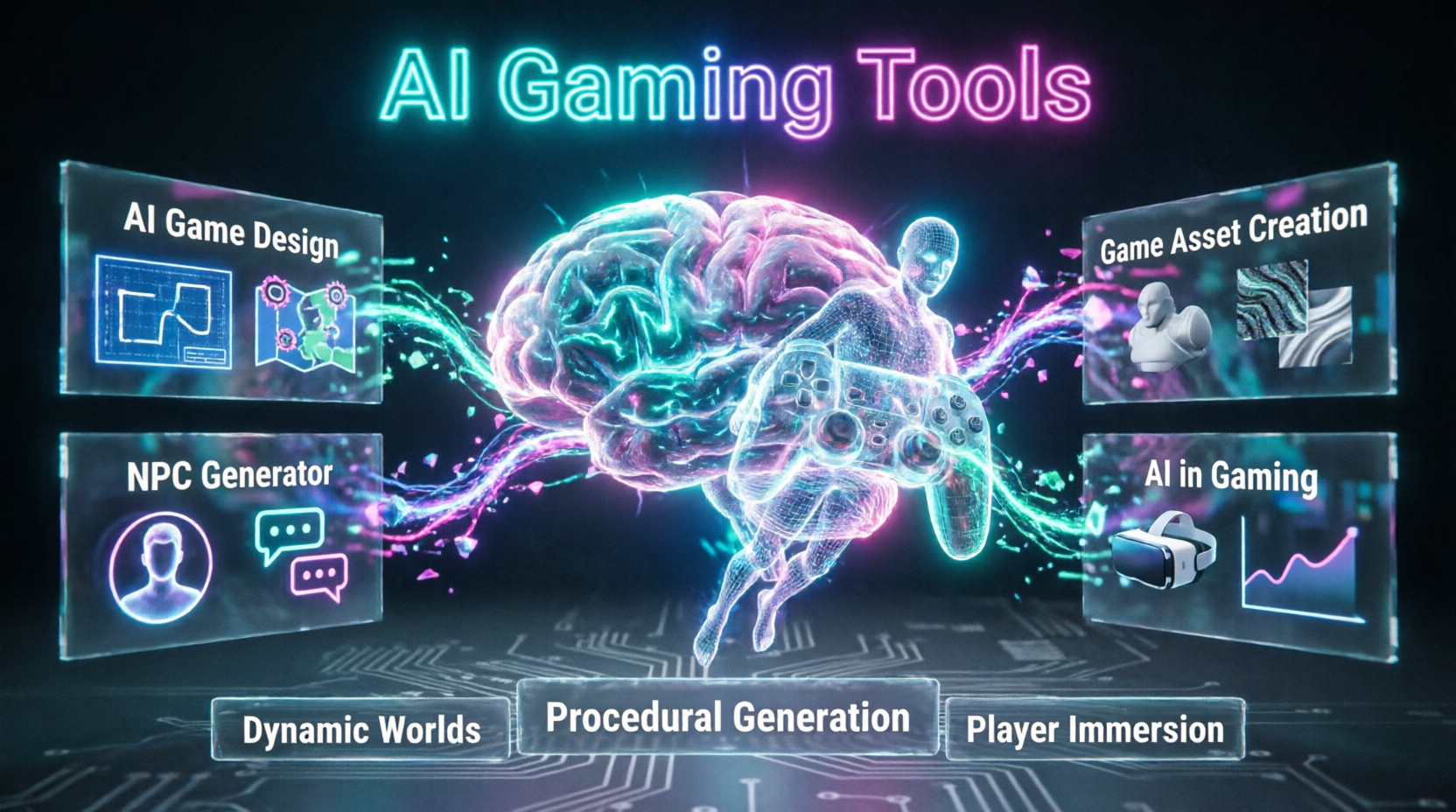
Mastering the deployment of AI gaming tools has become the definitive competitive advantage for modern game developers, indie studios, and hardcore gamers looking to push the boundaries of interactive entertainment. In an era where players demand hyper-realistic graphics, infinitely dynamic narratives, and seamless performance, relying on traditional, manual scripting and static asset pipelines is no longer a viable strategy for creating next-generation experiences. Today, forward-thinking studios and tech-savvy players are leveraging advanced machine learning, large language models (LLMs), and neural rendering to automate workflows, generate immersive worlds, and elevate gameplay. If you are looking to understand exactly how to integrate these technologies into your development pipeline or gaming setup, you are in the right place.
This comprehensive guide demystifies the landscape of intelligent gaming technology. We will explore the core capabilities of modern AI game design tools, detail the transformative impact of an AI NPC generator, and provide a strategic blueprint for utilizing AI game asset creation. By the end of this article, you will have a clear, actionable framework for understanding AI in gaming, selecting the right tools for your studio or rig, and driving measurable improvements in both development efficiency and player immersion.
1. The Evolution of Play: Why AI Gaming Tools Matter in 2026
Historically, game development was a highly manual, labor-intensive process. Designers spent thousands of hours hand-crafting level geometry, writers built rigid dialogue trees, and artists modeled every individual prop from scratch. While this approach yielded incredible art, it created massive bottlenecks, ballooning budgets, and static gameplay experiences that players could easily memorize and exploit.
The integration of AI gaming tools represents a quantum leap in interactive entertainment. Unlike legacy procedural generation that relied on simple mathematical noise, modern AI understands context, physics, and narrative structure. It can generate sprawling, coherent landscapes, write dynamic dialogue on the fly, and render photorealistic textures in seconds. According to recent industry reports from the Game Developers Conference (GDC), studios that strategically implement AI gaming tools report a 30-50% reduction in asset production time and a significant increase in player retention due to more dynamic, replayable worlds. This shift transforms game development from a rigid manufacturing process into a fluid, collaborative partnership between human creativity and machine intelligence.
2. Streamlining Development: Top AI Game Design Tools
For developers, the challenge is not just making a game, but making it efficiently without sacrificing quality. AI game design tools are revolutionizing the pre-production and level design phases, allowing smaller teams to build massive, AAA-quality worlds.
Procedural Level and World Generation Modern AI game design tools can generate complex, navigable 3D environments from simple text prompts or 2D sketches. By understanding architectural logic and gameplay flow, these tools can instantly populate a level with optimized geometry, lighting, and collision meshes. This allows level designers to focus on pacing and gameplay mechanics rather than manually placing every rock and tree.
Narrative and Quest Generation Writing branching narratives is notoriously difficult. AI-assisted design tools can help writers generate side quests, lore entries, and environmental storytelling elements. By feeding the AI the core rules of your game world, it can suggest logical quest chains, generate unique item descriptions, and ensure narrative consistency across thousands of lines of text.
Code Assistance and Bug Detection Game engines like Unity and Unreal Engine are increasingly integrating AI coding assistants. These tools can write boilerplate code, optimize complex shaders, and even predict and flag potential bugs or performance bottlenecks before the game is compiled, drastically reducing the QA testing phase.
3. Breathing Life into Worlds: The AI NPC Generator
Perhaps the most exciting advancement in AI gaming tools is the ability to create truly autonomous, intelligent characters. The era of the repetitive, three-line dialogue tree is ending.
LLM-Driven Dynamic Dialogue An advanced AI NPC generator integrates Large Language Models directly into the game engine. Instead of selecting from a pre-written list of responses, NPCs can understand player input via text or voice and generate unique, context-aware replies in real time. They remember past interactions, hold grudges, and adapt their personality based on the player’s actions, creating a deeply personalized role-playing experience.
Behavioral AI and Autonomous Agents Beyond dialogue, AI is transforming NPC behavior. Using reinforcement learning, NPCs can learn to navigate complex environments, coordinate tactical attacks, and react realistically to the player’s combat style. This creates enemies and allies that feel genuinely alive, unpredictable, and challenging, rather than following predictable, scripted patrol routes.
Emotional and Facial Animation Coupled with dynamic dialogue, AI tools can now generate real-time facial animations and lip-syncing. By analyzing the audio output of the LLM, the AI automatically drives the NPC’s facial rig to match the emotional tone and phonetic sounds of the speech, eliminating the need for manual keyframe animation for every line of dialogue.
4. Accelerating Production: AI Game Asset Creation
The visual and auditory fidelity of modern games requires an astronomical amount of assets. AI game asset creation tools are democratizing high-end production, allowing indie developers to compete with major studios.
Text-to-3D and Texture Generation Creating 3D models and PBR (Physically Based Rendering) textures traditionally takes days. AI asset tools can now generate high-quality, game-ready 3D models and seamless textures from simple text prompts or reference images. These tools automatically handle UV unwrapping, topology optimization, and normal map generation, turning a concept into a usable asset in minutes.
AI Motion Capture and Animation Motion capture suits are expensive and require specialized studios. AI-powered video-to-animation tools allow developers to upload a simple video of themselves performing an action, and the AI accurately extracts the skeletal motion data, applying it to a 3D character rig. This makes high-fidelity animation accessible to developers of all budget levels.
Procedural Audio and Music Sound design is critical for immersion. AI audio tools can generate dynamic, adaptive soundtracks that change tempo and instrumentation based on the in-game action (e.g., shifting from exploration to combat). They can also synthesize realistic sound effects, from footsteps on different materials to ambient environmental noise, without requiring a massive library of pre-recorded samples.
5. Enhancing the Experience: AI in Gaming for Players
While developers use AI to build games, players benefit from AI in gaming through enhanced performance, accessibility, and modding capabilities.
Neural Rendering and Upscaling Technologies like NVIDIA DLSS and AMD FSR use AI to render games at a lower internal resolution and then intelligently upscale them to 4K in real time. This provides a massive boost to frame rates without sacrificing visual fidelity, allowing gamers to play graphically demanding titles with ray tracing enabled on mid-tier hardware.
AI Mods and Community Content The modding community is leveraging AI gaming tools to create incredible user-generated content. From AI-generated high-resolution texture packs that remaster classic games, to custom AI companions that provide tactical advice, AI is empowering players to expand and personalize their favorite games in ways the original developers never imagined.
Accessibility and Adaptive Difficulty AI is making gaming more inclusive. Real-time AI can adjust the game’s difficulty dynamically based on the player’s performance, ensuring the game remains challenging but not frustrating. Additionally, AI-driven tools can generate real-time subtitles, translate text on the fly, and even interpret voice commands for players with motor disabilities.
6. Choosing the Right AI Gaming Tools for Your Studio or Setup
With a rapidly expanding market of gaming-tech vendors, selecting the right AI gaming tools requires careful evaluation of your specific needs, whether you are a solo developer or a AAA studio.
Engine Integration and Workflow Compatibility Your AI tools must integrate seamlessly into your existing pipeline. Look for AI game design tools and asset generators that offer native plugins for Unreal Engine, Unity, or Blender. Clunky, standalone tools that require complex file conversions will slow down your workflow and lead to developer frustration.
Performance and Hardware Requirements For developers, generating assets locally requires powerful GPUs. For players, AI upscaling and dynamic NPCs require significant computational overhead. Evaluate the hardware requirements of the tools you choose to ensure they don’t bottleneck your development machine or degrade the player’s frame rate.
Copyright and Ethical Considerations The use of AI in game development is a sensitive topic. When selecting AI game asset creation tools, ensure the vendor uses ethically sourced, licensed training data. Furthermore, establish clear internal guidelines on how AI-generated assets are used, ensuring you retain the necessary commercial rights and avoiding the plagiarism of existing artists’ styles.
Scalability and Cost Evaluate the pricing models carefully. Some tools charge per generated asset, while others offer unlimited subscriptions. For studios planning to generate thousands of assets, a scalable, enterprise-tier pricing model is essential to prevent costs from spiraling out of control as the project grows.
7. Comprehensive Query Coverage
What are the best AI gaming tools for indie developers? For indie developers, the best AI gaming tools are those that offer high impact with low overhead. Platforms like Scenario (for AI game asset creation), Inworld AI (for AI NPC generation), and Ludo AI (for game design and ideation) provide enterprise-grade capabilities that allow small teams to build expansive, high-fidelity games without massive budgets.
How does an AI NPC generator change gameplay? An AI NPC generator changes gameplay by removing the limitations of pre-written dialogue trees. NPCs can hold dynamic, unscripted conversations, remember past player interactions, and react logically to unexpected player actions. This creates a deeply immersive, emergent gameplay experience where no two playthroughs are exactly alike.
Can AI game asset creation replace human artists? No. AI game asset creation is designed to augment, not replace, human artists. While AI excels at generating base meshes, textures, and variations, it lacks the intentional artistic direction, emotional storytelling, and fine-tuned polish that human artists provide. The best workflow uses AI for the heavy lifting and humans for the creative direction and final refinement.
How is AI in gaming improving performance for players? AI in gaming improves performance primarily through neural upscaling (like DLSS) and frame generation. By using AI to predict and render frames, or upscale lower-resolution images in real time, players can achieve high frame rates and smooth gameplay on hardware that would otherwise struggle with modern graphical demands.
What are the ethical concerns regarding AI gaming tools? The primary ethical concerns involve copyright infringement (if the AI was trained on unlicensed art) and the potential displacement of human jobs. Studios must ensure they use ethically sourced AI tools, maintain human oversight in the creative process, and use AI to empower their teams rather than simply replace them.
Conclusion
Mastering AI gaming tools is no longer a futuristic concept reserved for tech giants; it is a present-day imperative for any developer or gamer looking to thrive in the next generation of interactive entertainment. By moving beyond manual, static pipelines and embracing the power of AI game design tools, AI NPC generators, and AI game asset creation, studios can unlock unprecedented levels of creativity, efficiency, and player immersion.
Whether you are deploying an AI NPC generator to create living, breathing worlds, utilizing AI game asset creation to accelerate your production pipeline, or leveraging AI in gaming to push your hardware to its absolute limits, the key to success lies in strategic, ethical integration. AI should not replace the human passion and artistic vision that define great games; rather, it should automate the technical heavy lifting, freeing creators to focus on storytelling, gameplay, and emotional connection.
As machine learning and neural rendering continue to evolve, the boundary between the virtual and the real will only blur further. Embrace the power of intelligent gaming technology today, and position your studio or gaming setup at the absolute forefront of the digital entertainment revolution.