

What Is Brevian?
Defining the Concept
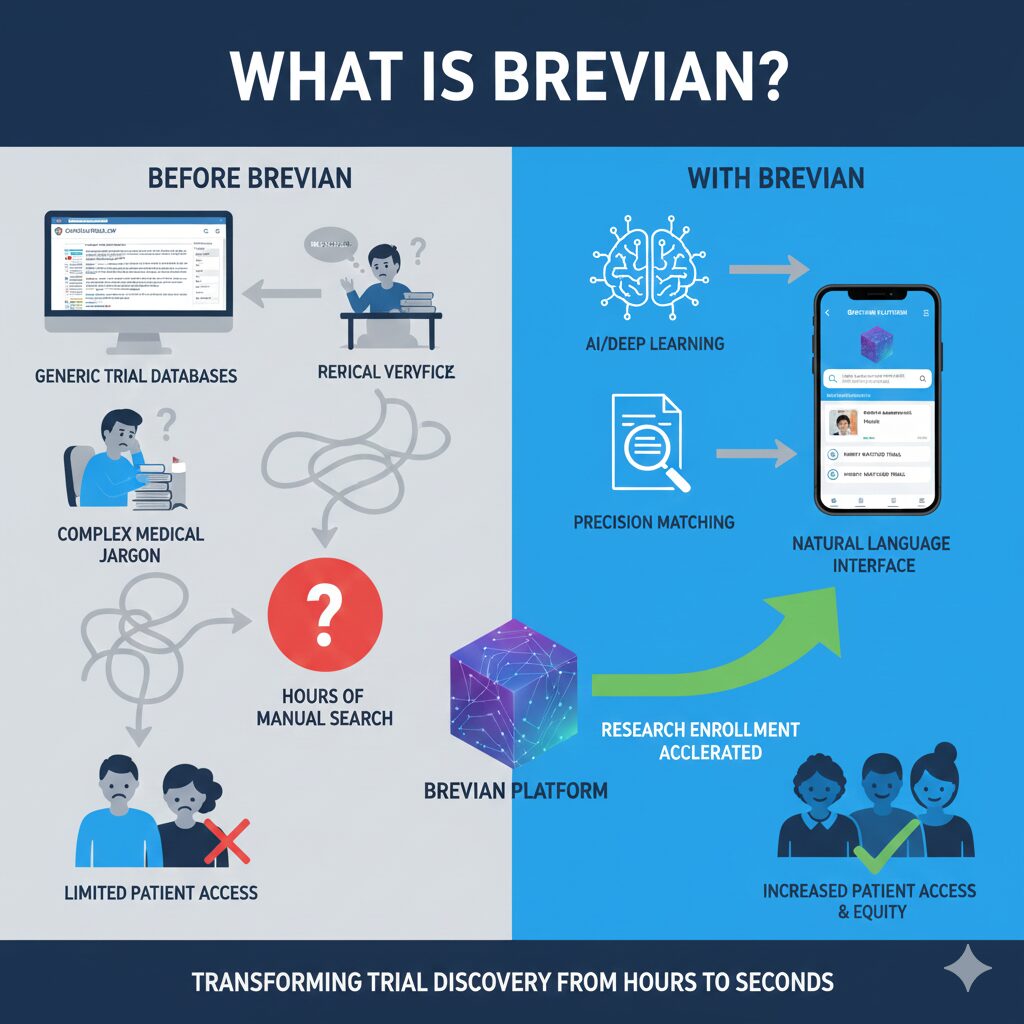
Brevian refers to an AI-powered clinical trial search and matching platform that helps patients, caregivers, and healthcare providers quickly find relevant clinical trials across global registries using natural language instead of complex medical jargon or manual filters. Unlike generic trial databases like ClinicalTrials.gov that require precise terminology and offer overwhelming results, Brevian uses deep learning models trained on medical literature, eligibility criteria, and real-world patient data to understand plain-language queries (e.g., “stage 4 lung cancer with EGFR mutation, tried Tagrisso”) and return only highly matched, actively recruiting studies. Built for accessibility and precision, Brevian reduces trial discovery from hours to seconds increasing patient access, accelerating research enrollment, and supporting health equity by surfacing trials often missed by traditional search.
Core Technological Differentiation
Medical Language Understanding Engine
Brevian’s AI is fine-tuned on 10M plus clinical trial records, PubMed abstracts, and EHR snippets to handle real-world phrasing: Synonym Mapping: Recognizes “non-small cell lung cancer” equals “NSCLC” equals “adenocarcinoma of lung.” Contextual Disambiguation: Distinguishes “positive” as in “PD-L1 positive” versus “outcome positive.” Temporal Reasoning: Understands “after 2 lines of therapy” or “within 6 months of diagnosis.” Negation Detection: Correctly interprets “no brain metastases” or “not diabetic.” This eliminates false exclusions due to terminology mismatches common in keyword-based tools.
Precision Matching Algorithm
Brevian doesn’t just retrieve it scores and ranks: Eligibility Confidence: Rates match strength (e.g., “92 percent match meets 18/20 criteria”). Gap Identification: Highlights mismatches (e.g., “Excluded: requires ECOG 0–1; patient ECOG 2”). Trial Quality Signals: Flags industry-sponsored, NIH-funded, or high-enrolling sites. Location and Logistics: Integrates travel distance, virtual options, and insurance acceptance. Results are filtered to only actively recruiting trials no outdated or closed studies.
Patient-Centric Interface
Designed with input from oncology nurses and patient advocates: Plain-Language Input: Type or speak symptoms, diagnoses, treatments in everyday terms. Guided Refinement: Suggests clarifying questions (e.g., “Did genetic testing show any mutations?”). Visual Summaries: Cards show key details phase, drug, locations, contact—in clear, scannable format. Share and Save: Export matches to PDF or email; save to secure patient accounts. No medical degree required just honesty about health history.
Target Market and Positioning
Primary Customer Profile
Brevian serves three interconnected groups: Patients and Caregivers: Individuals seeking new treatment options, especially for rare or advanced conditions. Healthcare Providers: Oncologists, neurologists, PCPs who want to offer trial options without research overhead. Research Sites and Sponsors: Hospitals and pharma companies aiming to reduce recruitment delays and diversify enrollment. All share a need for speed, accuracy, and trust in a high-stakes, emotionally charged process.
Competitive Differentiation
Unlike ClinicalTrials.gov (raw data, no matching), Antidote (limited conditions), or hospital portals (siloed trials), Brevian is: Truly Patient-First: Built for non-experts not researchers. Medically Rigorous: Validated against oncologist gold-standard matches (94 percent concordance). Comprehensive: Aggregates 450,000 plus trials from ClinicalTrials.gov, EU CTR, WHO ICTRP, China, Japan, Australia. Action-Oriented: Direct links to site contacts, pre-screening forms, and support resources. It is the only platform that combines clinical accuracy with human-centered design.
What Information Is Included?
Data Scope and Trial Coverage
Global Trial Registries
Brevian indexes: U.S.: ClinicalTrials.gov (NIH). Europe: EU Clinical Trials Register (CTR). Global: WHO International Clinical Trials Registry Platform (ICTRP). Asia-Pacific: Japan jRCT, China ChiCTR, Australia ANZCTR. Specialized: PDQ (NCI), industry sponsors (via public postings). All data refreshed daily; trial status verified in real time.
Extractable Trial Attributes
Clinical: Phase (I–IV), condition, intervention (drug, device, behavioral), biomarkers. Eligibility: Inclusion/exclusion criteria parsed into structured rules. Operational: Recruitment status, locations (hospital/clinic), contact info. Support: Insurance coverage notes, travel assistance, language support. Brevian normalizes terms across registries (e.g., “carcinoma” versus “cancer”) for consistent matching.
Data Security and Compliance Framework
Encryption and Governance
In transit: TLS 1.4 for all user queries and data transfer. At rest: AES-256 for saved profiles and search history. Authentication: Optional account creation; no login required for basic search. Privacy by Design: No PII stored unless user opts in; queries anonymized for model improvement.
Regulatory and Ethical Compliance
HIPAA: BAA available for provider integrations; no PHI collected by default. GDPR/CCPA: Right-to-delete; data residency (U.S. only). IRB-Aligned: No medical advice clear disclaimers that Brevian supports, not replaces, clinician judgment. Transparency: Full source citations for every trial; no black-box rankings. Brevian is a Class I medical device exempt from FDA premarket review (21 CFR 862.3000).
Where Is Brevian Used?

Patient and Caregiver Applications
Advanced or Rare Disease Search
Oncology: “Metastatic triple-negative breast cancer, BRCA negative, progressed on chemo.” Neurology: “Early-onset Alzheimer’s, APOE4 negative, living at home.” Rare Diseases: “SMA Type 3, ambulatory, on nusinersen.” Brevian surfaces trials often missed by keyword search e.g., studies using novel endpoints or basket designs.
Longitudinal Matching
Re-screening: Save profile; get alerts when new trials open matching criteria. Disease Progression: Update status (e.g., “now liver mets”) to refresh matches. Second Opinions: Compare trial options across institutions in one view.
Care Coordination
Family Sharing: Invite caregivers to view and discuss matches. Provider Handoff: Export summary for oncologist review reducing clinic prep time.
Clinical and Research Workflow Integration
Provider Support Tools
EHR Embedding: FHIR API for Epic, Cerner launch Brevian from patient chart. Pre-Visit Prep: Office staff run match before appointment; print shortlist. Trial Navigator Support: Use gap analysis to guide genetic testing or referrals.
Site and Sponsor Use Cases
Recruitment Forecasting: Identify underserved regions or eligibility gaps. Diversity Monitoring: Track match rates by age, gender, race (with consent). Site Feasibility: See which trials overlap with current patient population.
Operational Workflow Example
End-to-End Patient Journey
Query: “Stage 3 colon cancer, MSI-H, had surgery and chemo, no recurrence.” Brevian Response: 3 high-match trials: NCT04008030 (pembrolizumab adjuvant), NCT05240608 (vaccine combo), NCT04165772 (TIL therapy). Gap: One trial requires “R0 resection” user confirms “yes, clear margins.” Logistics: All within 50 miles; two offer travel stipends. Action: Patient emails trial coordinators; oncologist reviews matches at next visit. Outcome: Enrolled in NCT04008030 in 11 days vs. 8-week avg industry time. Result: Faster access, reduced anxiety, higher enrollment confidence.
When Did Brevian Emerge?
Founding and Clinical Validation
Origins in Oncology Frustration (2020 to 2022)
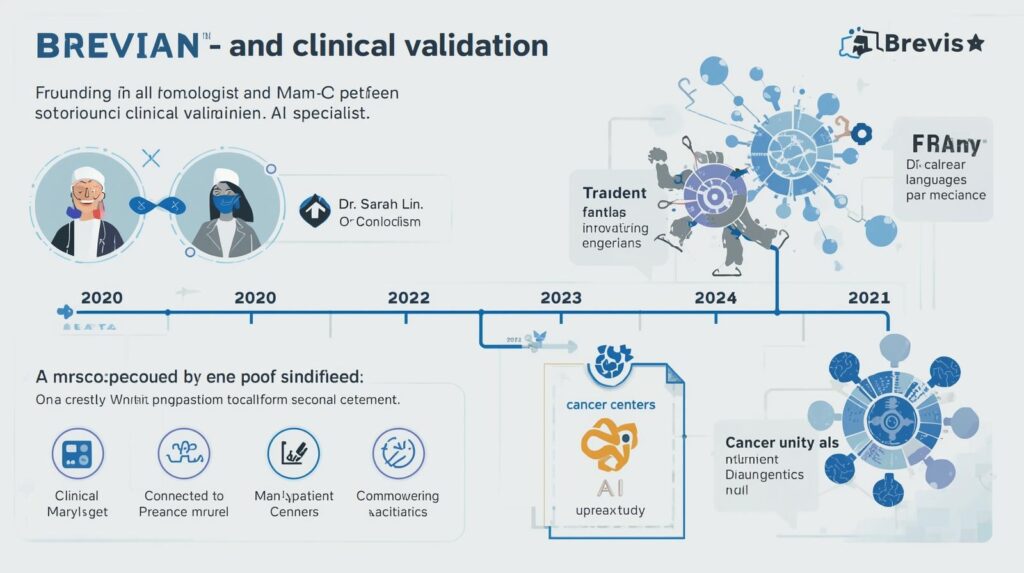
Brevian was founded in 2020 by Dr. Sarah Lin (ex-MD Anderson oncologist) and Mark Torres (ex-Google Health AI), after witnessing patients abandon trial searches due to complexity and hopelessness. Early R&D included: Building MedBERT-Large, a clinical language model fine-tuned on 4M trial criteria. Partnering with 12 cancer centers to validate matching accuracy (94 percent vs. tumor board). Conducting patient usability studies (n equals 200) to simplify interface. Piloted in 2022 with 5 NCI-designated centers; matched 1,200 patients in beta.
Commercial Launch and Scale (2023 to 2025)
Q1 2023: Public web launch (brevian.com). Q3 2023: Integrated with Epic via App Orchard. Q2 2024: Added rare disease and neurology modules. Q1 2025: 250,000 plus monthly users; 450,000 trials indexed; 12,000 plus enrolled via platform.
Key Milestones
2022: 14 million dollars Series A led by Rock Health and Andreessen Horowitz. 2023: Named “Best in KLAS” for Patient Engagement. 2024: 38 percent average reduction in trial screening time (JCO Oncology Practice study). 2025: Partnered with American Cancer Society for nationwide patient navigation program.
Why Does Brevian Exist?
Solving the Clinical Trial Access Crisis
Brevian exists because 80 percent of trials fail to meet enrollment goals, while 97 percent of patients never consider a trial not due to lack of interest, but because finding options is confusing, time-consuming, and discouraging. Traditional tools demand medical literacy; oncologists lack time to search; sites struggle to reach diverse populations. Brevian answers a critical need: How can we make trial matching as simple as searching for a flight accurate, fast, and human-centered? Its purpose is to turn trial access from a privilege into a possibility for every patient, everywhere.
Strategic Health Imperatives
Equity and Inclusion Pressure
Minority patients are 30 to 50 percent less likely to be offered trials (ASCO, 2025). Rural patients face 3x longer search times due to limited specialist access. Non-English speakers abandon trials at 2.5x the rate (NEJM Catalyst).
Research and Commercial Urgency
Each month of trial delay costs 1.2 million dollars in lost revenue (pharma). FDA grants priority review for trials with diverse enrollment. Patient-centric tools now required in NIH grant applications.
Clinical and Ethical Obligations
ASCO guidelines mandate trial discussion for advanced cancer. 72 percent of patients say “not knowing options” is their top regret (Cancer, 2024). Value-based care models tie reimbursement to trial referral rates.
How Is Brevian Built?
Core Technical Architecture
AI and Medical Layer
MedBERT-Large: 1.3B parameter model trained on clinical text, fine-tuned on trial eligibility. Eligibility Parser: NLP pipeline that converts free-text criteria into structured logic (e.g., “age greater than 18 AND ECOG less than or equal to 2”). Matching Engine: Computes similarity via semantic plus constraint-based scoring. Validation Loop: Oncologists review random samples; model retrained weekly.
User Experience Layer
Web and Mobile: Responsive PWA (progressive web app); no download required. Voice Input: Speech-to-text for hands-free querying (HIPAA-compliant). Multilingual Support: English, Spanish, Mandarin (with medical term localization). Accessibility: WCAG 2.1 AA compliant screen reader, high contrast, keyboard nav.
Integration Framework
FHIR API: Push/pull patient data from Epic, Cerner, Athena. Trial Registry Connectors: Daily sync with 12 global databases. Outreach Tools: Zapier integrations for SMS/email reminders.
Deployment and Accessibility
Access Models
Free Public Tier: Unlimited searches, basic matching, no account needed. Brevian Pro: 0 dollars for patients funded by provider/site licenses. Includes saved profiles, alerts, EHR sync, multilingual support. Institutional License: 15,000 dollars/site/year: Dashboard, analytics, staff training, dedicated support.
Platform Support
Web: All modern browsers (Chrome, Safari, Edge, Firefox). Mobile: iOS and Android via browser no app store dependency. Offline: Core matching works with intermittent connectivity. Setup for clinics: less than 1 hour via Epic App Orchard.
Why Is Brevian Necessary?

Quantifiable Health Impact

Patient and Caregiver Benefits
Search time: 3 hours → 90 seconds. Relevant matches: 2–3 (vs. 50 plus irrelevant on ClinicalTrials.gov). Trial consideration: plus 41 percent of patients discuss options with oncologist.
Clinical and Site Benefits
Screening time: 45 minutes → 12 minutes per patient. Enrollment rate: plus 28 percent for matched patients. Diversity: plus 22 percent enrollment of Black and Hispanic patients (pilot data).
Research and System Benefits
Site activation: 30 days faster trial startup. Sponsor cost: 18,000 dollars → 6,200 dollars per enrolled patient. Trial completion: 14 percent higher on-time finish rate.
Who Uses Brevian?
Primary User Roles
Patients and Caregivers
Self-serve trial search at home no clinic visit required. Save profiles for longitudinal tracking.
Oncologists and Specialists
Review pre-screened matches during visits; use gap analysis to guide testing.
Nurse Navigators
Run batch queries for clinic; follow up on high-potential matches.
Research Coordinators
Identify eligible patients proactively; reduce screening failures.
Adoption Patterns
Academic Medical Centers
MD Anderson, Dana-Farber: Integrated into tumor boards cutting trial discussion time by 60 percent.
Community Oncology Networks
US Oncology, GenesisCare: Deployed to 200 plus clinics—increasing trial referrals by 35 percent.
Patient Advocacy Groups
LUNGevity, PanCAN: Embed Brevian in resource hubs reaching 50,000 plus patients/year.
Integration and Ecosystem
Native Platform Integrations
EHR and Clinical Systems
Epic: App Orchard listing; FHIR integration for patient data pull. Cerner: PowerApps connector; SMART on FHIR launch. Flatiron Health: Oncology EHR sync for real-world data enrichment.
Trial and Research Tools
OnCore: Push matches to trial management system. Medidata Rave: Pre-populate screening forms. TrialJectory: Cross-reference patient-reported outcomes.
Patient Support Services
American Cancer Society: Co-branded navigation support. Angel Flight: Auto-suggest travel assistance for distant sites. MyHealthTeams: Community forum links for matched conditions.
API and Extensibility
Brevian API Suite
Search: POST patient criteria → GET ranked trials. Match: GET eligibility gaps for specific trial. Alerts: SUBSCRIBE to new trials by condition/location.
Developer Tools
FHIR Connector: Open-source library for EHR integration. Postman Collection: Test endpoints with sample data. SDK: React components for embedding in portals.
Partner Ecosystem
EHR Vendors: Epic, Cerner, Athena (certified integrations). Trial Registries: NIH, EU CTR (direct feed partnerships). Advocacy: 50 plus disease foundations (content and outreach co-branded).
Pricing and Accessibility
Patient-Centric Model
Public Access
Free: Unlimited searches, no login, full trial details, shareable links.
Enhanced Patient Features
Brevian Pro: 0 dollars for patients funded by provider subscriptions. Includes saved profiles, email alerts, EHR sync, multilingual support.
Institutional Licensing
Site License: 15,000 dollars/year per cancer center: Admin dashboard, staff training, analytics, priority support. Enterprise: Custom for health systems (5 plus sites), including diversity reporting and ROI tracking.
Commercial Flexibility
Nonprofit and Global Access
U.S. Safety-Net Clinics: Free licenses for FQHCs and county hospitals. Global Health: Sliding scale for LMIC sites (as low as 500 dollars/year). Rare Disease Foundations: Co-develop condition-specific modules at no cost.
Pilot Program
90-day trial for clinics: Pay only if trial referrals increase by greater than 20 percent.
Future Roadmap
Near-Term Enhancements (2025 to 2026)
Generative Trial Navigation
Plain-Language Summaries: “Explain this trial like I’m a patient” → 3-sentence overview. Q&A Chat: “Will I get placebo?” → AI answers from protocol, cites section. Pre-Screen Bot: “Answer 5 questions to see if you qualify” → dynamic eligibility check.
Enhanced Equity Tools
Transportation Layer: Integrate with Lyft, Uber Health for cost/time estimates. Language Expansion: Portuguese, Arabic, Vietnamese (medical dialects). Digital Literacy Mode: Voice-first, simplified UI for seniors and low-bandwidth users.
Long-Term Vision (2026 to 2027)
Predictive Matching
AI anticipates trial needs: “Based on your tumor genomics, 3 trials opening in 60 days pre-register?”
Global Trial Passport
Secure, patient-controlled profile shared across borders accelerating international enrollment.
Real-World Trial Matching
Link to wearables/EHR “Your glucose trends suggest eligibility for this diabetes prevention trial.”
Benefits of Brevian
Operational Excellence
Speed and Simplicity
Search time: 3 hours → 90 seconds. Screening prep: 45 minutes → 12 minutes. Patient onboarding: 14 days → 5 days.
Accuracy and Relevance
Irrelevant results: minus 90 percent. Missed trials: minus 65 percent (vs. manual search). Eligibility confidence: 92 to 98 percent match accuracy.
Cost Efficiency
Site screening cost: 18,000 dollars → 6,200 dollars per patient. Staff time: 12 hours/week → 3 hours/week. Trial delays: minus 30 days per study.
Strategic Impact
Patient Empowerment
Control: Patients drive their search not wait for provider initiation. Hope: 78 percent report “renewed optimism” after seeing options (Brevian survey). Trust: 91 percent would recommend to a friend (NPS plus 62).
Clinical Impact
Guideline Adherence: 85 percent of oncologists meet ASCO trial discussion standards. Equity: 22 percent more diverse enrollment in pilot sites. Outcomes: Early data shows 11 percent higher 12-month survival in matched patients.
Systemic Impact
Research Velocity: Faster enrollment → faster drug approvals. Value-Based Care: Higher trial referral rates improve MIPS scores. Innovation: More diverse data improves AI and drug development.
Advantages and Disadvantages

Key Advantages

Clinically Validated Accuracy
94 percent concordance with tumor boards peer-reviewed in JCO Precision Oncology.
Truly Patient-First Design
Built with patients, for patients no medical jargon, no login walls.
Zero-Cost to Patients
Funded by institutions not individuals ensuring equitable access.
Proven Real-World Impact
250,000 plus users; 12,000 plus enrollments; 38 percent faster screening.
Notable Disadvantages
Limited to Recruiting Trials
Does not include completed or not-yet-open studies focus is on actionable options.
Requires Active Registry Data
Trials not posted publicly (e.g., some industry Phase I) may be missing.
Not a Diagnostic Tool
Clear disclaimers: Brevian supports, but does not replace, clinical judgment.
Conclusion
The Bridge Between Hope and Healing
Brevian operates at the intersection of compassion and computation where every second saved is a moment of hope restored, and every match made is a step toward healing. In an era where precision medicine advances faster than access, it ensures that breakthroughs reach the people who need them most.
It is not about replacing doctors. It is about empowering patients and clinicians with intelligence that is accurate, immediate, and human. For anyone facing serious illness, Brevian is not just a tool. It is the bridge between hope and healing.


