

The Future of AI

Defining the Trajectory of Artificial Intelligence
The future of AI represents a multidimensional evolution across technology, society, economics, and ethics. It is not a single endpoint but a dynamic convergence of increasingly capable systems that augment human intelligence, automate complex decision-making, and reshape industries, governance, and daily life. Unlike narrow AI of the past which excelled at specific tasks like image recognition or language translation next-generation AI aims for general reasoning, contextual awareness, and goal-directed autonomy, moving closer to artificial general intelligence (AGI).
This trajectory is driven by advances in foundational models, multimodal learning, agentic architectures, and neuro-symbolic integration. But the future of AI is not just about smarter algorithms it is about how humans choose to design, deploy, govern, and coexist with intelligent systems. The decisions made in the next decade will determine whether AI becomes a force for broad-based human flourishing or a source of inequality, manipulation, and systemic risk.
Why the Next Decade Is Pivotal
We are entering what experts call the “deployment era” of The Future of AI where theoretical capabilities meet real-world scale. Models are no longer confined to research labs; they power healthcare diagnostics, financial trading, legal analysis, education, and national defense. With this scale comes unprecedented influence and responsibility.
Several converging forces make the 2025–2035 window critical:
- Exponential growth in model capabilities (e.g., reasoning, planning, tool use)
- Global regulatory momentum (EU AI Act, U.S. Executive Orders, UN frameworks)
- Economic realignment as AI reshapes labor markets and value chains
- Geopolitical competition over AI leadership between the U.S., China, and the EU
- Public awareness and demand for transparency, safety, and fairness
How societies navigate these forces will define the long-term trajectory of human-AI coexistence.
Technological Frontiers
From Narrow AI to Agentic Intelligence
Current The Future of AI systems are largely reactive: they respond to prompts but do not initiate, plan, or persist toward goals. The next leap is agentic AI systems that can:
- Break down complex objectives into subtasks
- Use tools (APIs, browsers, code interpreters) to gather information or act
- Reflect on outcomes and self-correct
- Collaborate with other agents or humans in real time
Emerging frameworks like AutoGPT, CrewAI, and Microsoft’s AutoGen demonstrate this shift. In the future, AI won’t just answer “What’s the weather?” but “Plan a week-long team offsite in Lisbon under $10,000, considering everyone’s dietary needs and flight preferences”—executing research, booking, and coordination autonomously.
Multimodal and Embodied AI
The Future of AI will transcend text. Multimodal models process and generate combinations of text, images, audio, video, sensor data, and 3D environments. This enables richer understanding: an AI could watch a factory video feed, diagnose a machine malfunction from sound and motion, and generate a repair manual with annotated diagrams.
Embodied AI takes this further by operating in physical or simulated worlds robots that learn from trial and error, autonomous vehicles that navigate complex urban environments, or digital twins that simulate city traffic to optimize infrastructure. These systems close the loop between perception, reasoning, and action.
Small Language Models and Edge AI
While large models dominate headlines, the future also belongs to small language models (SLMs) compact, efficient AIs that run on smartphones, cars, or medical devices without cloud connectivity. Models like Microsoft’s Phi-3 or Google’s Gemma offer 80–90% of LLM performance at a fraction of the cost and latency.
This enables privacy-preserving, real-time AI for sensitive applications: mental health chatbots that never leave your phone, surgical assistants that process video feeds in operating rooms, or industrial sensors that detect anomalies on-site. Edge AI democratizes access and reduces reliance on centralized cloud providers.
AI-Native Infrastructure and Development
Software itself is being reimagined for AI. AI-native applications are built around agents, memory, and tool use not static interfaces. Development shifts from coding to prompt engineering, agent orchestration, and retrieval design.
Platforms like LangChain, LlamaIndex, and Vercel v0 enable developers to compose The Future of AI workflows as easily as building websites. In the future, creating a customer service bot may require no code—just defining goals, data sources, and guardrails. This lowers barriers to innovation but demands new skills in AI literacy and system design.
Societal and Economic Impact
The Future of Work and Labor Markets
The Future of AIwill not eliminate work but it will radically redefine it. Routine cognitive tasks (data entry, basic coding, report writing) will be automated, while demand surges for roles involving judgment, creativity, emotional intelligence, and AI collaboration.
Key trends include:
- Augmentation over replacement: Radiologists using The Future of AI detect tumors faster; teachers using AI to personalize lesson plans
- New job categories: AI ethicists, prompt engineers, synthetic data curators, agent trainers
- Hybrid human-AI teams: Customer support agents assisted by real-time AI suggestions; designers co-creating with generative tools
However, transition risks are real. Without proactive reskilling and social safety nets, AI could widen inequality. The challenge is not technological it is political and educational.
Education and Lifelong Learning
Education systems must evolve from rote memorization to critical thinking, AI literacy, and adaptive learning. Students will learn to:
- Evaluate AI outputs for bias and accuracy
- Use AI as a research and creativity partner
- Understand the ethical implications of algorithmic systems
AI tutors will provide personalized, 24/7 support—adapting to each student’s pace and learning style. But human mentorship, peer collaboration, and character development remain irreplaceable. The future classroom is human-led, AI-enhanced.
Healthcare Transformation
AI will enable predictive, preventive, and personalized medicine. Examples include:
- Early disease detection from retinal scans or voice patterns
- Drug discovery accelerated from years to months
- Mental health support via empathetic, always-available chatbots
- Robotic surgery with superhuman precision
Yet, trust, equity, and consent are paramount. AI must augment not replace clinician judgment, and access must be universal, not limited to the wealthy.
Ethical, Governance, and Safety Challenges
Aligning AI with Human Values
As The Future of AI systems gain influence, ensuring they act in accordance with human rights, democratic values, and cultural diversity becomes critical. This requires:
- Constitutional AI: Training models to self-edit against ethical principles
- Value pluralism: Avoiding Western-centric norms in global AI systems
- Participatory design: Involving diverse communities in AI development
The goal is not just “safe” AI, but wise AI systems that understand context, nuance, and long-term consequences.
Global AI Governance
No single nation can govern AI alone. The future demands international cooperation on:
- Standards for high-risk AI (e.g., biometrics, critical infrastructure)
- Transparency requirements (model cards, data provenance, audit trails)
- Arms control for autonomous weapons
- Data and compute sharing to prevent monopolies
Initiatives like the UN Advisory Body on AI, the Global Partnership on AI (GPAI), and the Bletchley Declaration are early steps—but binding frameworks are urgently needed.
Existential and Systemic Risks
Beyond bias and job loss, advanced The Future of AI poses systemic risks:
- Autonomous cyberattacks that adapt faster than human defenders
- AI-driven disinformation that erodes shared reality
- Loss of human agency as decisions are outsourced to opaque systems
- Race dynamics where safety is sacrificed for speed
Leading The Future of AI labs now employ AI safety researchers and run “red teaming” exercises to stress-test models. Some advocate for compute thresholds that trigger regulatory review similar to nuclear safeguards.
The Human-AI Relationship
From Tools to Collaborators
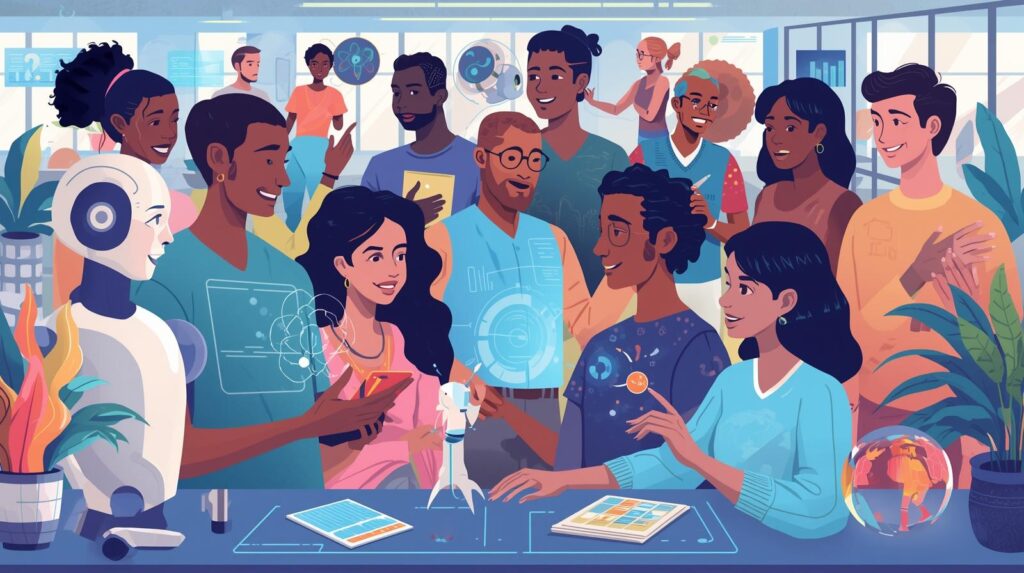
The future of AI is not human versus machine, but human with machine. AI will become a silent partner in creativity, science, and daily life like a tireless research assistant, a patient tutor, or a vigilant safety monitor.
This requires new interaction paradigms:
- Natural dialogue instead of rigid commands
- Explainability so users understand AI reasoning
- Controllability to override or adjust AI behavior
- Emotional attunement in caregiving or education contexts
The best AI will feel less like a robot and more like a thoughtful colleague.
Preserving Human Dignity and Purpose
As The Future of AI handles more tasks, societies must reaffirm what makes us human: curiosity, compassion, moral reasoning, and the search for meaning. Technology should expand not contract—human potential.
This means designing AI that:
- Enhances autonomy, not dependency
- Respects privacy and mental well-being
- Supports democratic participation and civic engagement
- Celebrates diverse forms of intelligence and contribution
Conclusion

Shaping an Intelligence-Augmented Future
The future of AI is not predetermined. It is being written today in code, policy, classrooms, boardrooms, and public discourse. The technologies emerging in 2025 lay the foundation for a world where intelligence is abundant, but wisdom remains human.
The greatest opportunity is not efficiency or profit, but solving humanity’s hardest problems: climate change, disease, poverty, and conflict. AI can accelerate progress but only if guided by ethics, equity, and empathy.


