

Artificial Intelligence (AI) is a broad and evolving field that encompasses various technologies, methodologies, and applications. AI systems are designed to simulate human intelligence by performing tasks such as learning, reasoning, problem-solving, perception, and decision-making.
In this article, we will explore the different types of AI, categorized based on capabilities, functionalities, and learning methods. Understanding these distinctions helps in identifying the right AI solution for specific use cases — whether it’s for business automation, customer service, healthcare, or scientific research.
Classification of Types of AI Based on Capabilities

AI can be classified into three main categories based on its ability to perform human-like tasks:
1. Narrow AI (Weak AI)
Definition: AI designed and trained to perform a specific task or set of tasks. It does not possess general cognitive abilities.
Examples:
- Siri, Alexa, and Google Assistant
- Image recognition software
- Chatbots for customer service
- Recommendation engines (e.g., Netflix, Amazon)
Characteristics:
- Focused on one domain
- Does not understand context beyond its function
- Cannot learn outside predefined parameters
This is the most common type of AI used today.
2. General AI (Strong AI)
Definition: AI with the ability to understand, learn, and apply knowledge across different domains — similar to human intelligence.
Examples:
Currently theoretical; no real-world examples exist yet.
Characteristics:
- Can reason, plan, and solve problems independently
- Understands emotions, beliefs, and intentions
- Adapts to new situations without retraining
General AI remains under development and is considered the next major milestone in AI research.
3. Superintelligent Types of AI
Definition: AI that surpasses human intelligence in every aspect, including creativity, wisdom, and problem-solving.
Examples:
Purely speculative at this stage, often discussed in philosophical and ethical debates.
Characteristics:
- Outperforms humans in all cognitive tasks
- Autonomous self-improvement
- Raises concerns about control and ethics
This level of AI is still a topic of science fiction and long-term research.
Classification of Types of AI Based on Functionality

AI can also be grouped based on how it functions and interacts with data:
1. Reactive Machines
Description: The simplest form of AI that reacts to current inputs without memory or past experiences.
Example: IBM’s Deep Blue chess-playing system.
Features:
- No memory or learning from past actions
- Reacts only to current situations
- Limited application scope
2. Limited Memory Types of AI
Description: Systems that use historical data to make decisions, often in real-time environments.
Example: Self-driving cars that use sensor data to inform driving decisions.
Features:
- Stores short-term data for contextual understanding
- Learns from recent experiences
- Common in modern AI applications like autonomous vehicles and recommendation systems
3. Theory of Mind Types of AI
Description: Hypothetical AI capable of understanding human emotions, beliefs, and social interactions.
Current Status: Still in early research stages.
Potential Uses:
- Advanced mental health support
- Human-AI collaboration
- Emotional intelligence in virtual assistants
4. Self-Aware Types of AI
Description: AI that possesses consciousness, self-awareness, and an understanding of internal states.
Current Status: Exists only in theory and science fiction.
Implications:
- Ethical and existential questions arise
- Potential for independent goals and behaviors
- Long-term future of AI development
Types of Types of AI Based on Learning Methodology
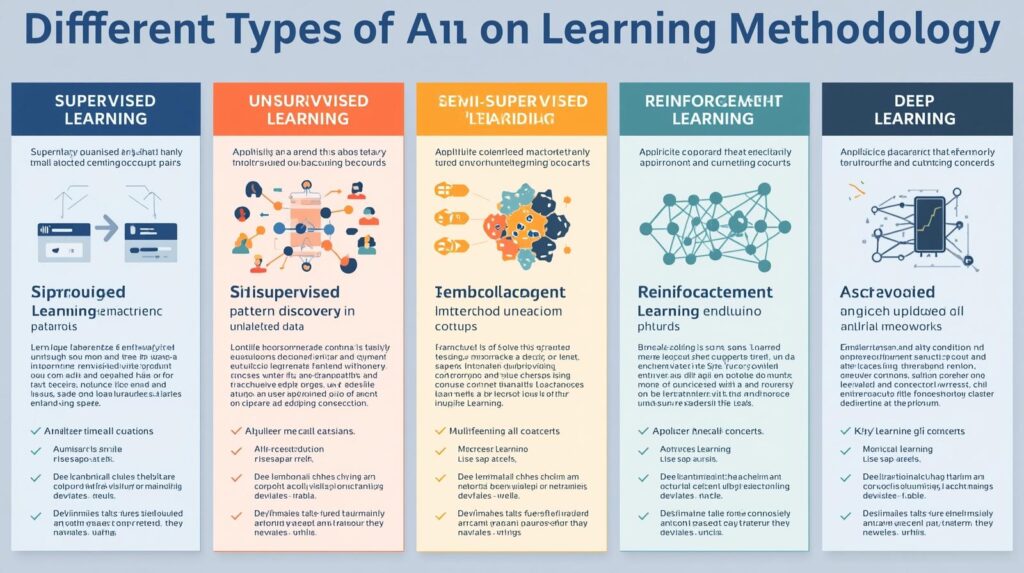
AI systems can also be differentiated by the way they learn and process information. These categories reflect the underlying machine learning techniques used:
1. Supervised Learning
Definition: AI learns from labeled datasets where input-output pairs are provided.
Use Cases:
- Spam detection
- Sales forecasting
- Medical diagnosis prediction
Tools & Models: Linear Regression, Decision Trees, Support Vector Machines (SVM), Neural Networks
2. Unsupervised Learning
Definition: AI learns from unlabeled data to find hidden patterns or groupings.
Use Cases:
- Customer segmentation
- Anomaly detection
- Clustering analysis
Tools & Models: K-means Clustering, Principal Component Analysis (PCA)
3. Semi-Supervised Learning
Definition: Combines supervised and unsupervised learning using both labeled and unlabeled data.
Use Cases:
- Large-scale image classification
- Natural language processing with limited labeled data
Benefits:
- Reduces the cost of labeling large datasets
- Effective when full supervision is impractical
4. Reinforcement Learning
Definition: AI learns through trial and error, receiving feedback in the form of rewards or penalties.
Use Cases:
- Game playing (e.g., AlphaGo)
- Robotics
- Resource management
Key Concepts: Agent, Environment, Reward System
5. Deep Learning
Definition: A subset of machine learning that uses multi-layered neural networks to model complex patterns in data.
Use Cases:
- Speech and image recognition
- Language translation
- Autonomous vehicles
Technologies Involved: Convolutional Neural Networks (CNNs), Recurrent Neural Networks (RNNs), Transformers
Functional Categories of Types of AI

Based on their purpose and application, AI can also be grouped into the following functional categories:
| Category | Description | Examples |
| Analytical AI | Focuses on logical intelligence and problem-solving | Predictive analytics, financial modeling |
| Human-Inspired AI | Incorporates emotional and cognitive intelligence | Virtual assistants, chatbots |
| Humanized AI | Mimics human behavior and decision-making | Smart home devices, personal AI companions |
Summary Table: Types of AI

| Type of AI | Description | Real-World Use | Current Availability |
| Narrow AI | Specializing in a single domain | Voice assistants, chatbots | Widely Available |
| General AI | Matches human-level intelligence | Future applications | Not Yet Available |
| Superintelligent AI | Exceeds human intelligence | Hypothetical scenarios | Theoretical |
| Reactive Machines | Reacts to current inputs only | Chess programs | Available |
| Limited Memory AI | Uses past data to inform decisions | Autonomous vehicles | Available |
| Theory of Mind AI | Understands human emotions and thoughts | Mental health support | Under Research |
| Self-Aware AI | Conscious and self-reflective | Science Fiction | Theoretical |
| Supervised Learning | Trained on labeled data | Fraud detection | Used Today |
| Unsupervised Learning | Learns from unlabeled data | Market basket analysis | Used Today |
| Reinforcement Learning | Learns through trial and error | Game AI, robotics | Used Today |
| Deep Learning | Uses neural networks for pattern recognition | Image and speech recognition | Used Today |
Final Thoughts
Understanding the types of AI is essential for anyone looking to implement or study artificial intelligence. Whether you’re a developer, business leader, or student, knowing the difference between Narrow AI and General AI, or between supervised and reinforcement learning, helps in selecting the right tools and strategies for your needs.
As AI continues to evolve, so too will its classifications. While much of today’s focus remains on Narrow AI and deep learning models, ongoing research is pushing us closer to more advanced forms of AI that could revolutionize society in the coming decades.
Frequently Asked Questions (FAQ)
Below are answers to some of the most commonly asked questions about the types of AI:
Q1: What are the main types of AI based on capability?
The main types are Narrow AI, General AI, and Superintelligent AI, each representing increasing levels of intelligence and autonomy.
Q2: What is Narrow AI, and where is it used?
Narrow AI is designed to perform specific tasks and is widely used in areas like voice recognition, recommendation systems, and fraud detection.
Q3: Is General AI available now?
No, General AI is still in development and remains a goal for future AI research.
Q4: What is the difference between supervised and unsupervised learning?
Supervised learning uses labeled data to train models, while unsupervised learning finds patterns in unlabeled data.
Q5: What is Deep Learning?
Deep Learning is a type of machine learning that uses neural networks to model complex patterns in data, commonly used in image and speech recognition.


