

What Is Parsio?

Defining the Concept

Parsio refers to a cloud-based email parsing and data extraction platform that enables businesses to automatically convert unstructured emails, attachments, and forms into structured, actionable data without manual copying, coding, or custom development. Unlike generic email automation tools that only route or flag messages, Parsio uses machine learning and rule-based parsing to read the content of emails (including PDFs, images, and HTML), identify key fields (e.g., invoice number, order date, customer name), and deliver clean data to CRMs, ERPs, databases, and workflow tools via API, webhook, or direct integration. Built for operations, finance, sales, and logistics teams, Parsio eliminates data entry bottlenecks, reduces errors, and turns email a universal but chaotic channel into a reliable, automated data pipeline.
Core Technological Differentiation
Multi-Modal Email Parsing Engine
Parsio processes diverse email content using three complementary methods: Rule-Based Parsing: Users define extractors using visual point-and-click tools (e.g., “Take text after ‘Invoice #:’”) ideal for consistent templates. Machine Learning Models: Trained on thousands of documents to handle variability (e.g., handwritten invoices, multi-language POs). OCR and Attachment Processing: Extracts text from PDFs, scanned images, and screenshots; parses tables in Excel/email bodies. All methods work together rules handle structure, ML handles noise, OCR handles images ensuring greater than 95 percent field-level accuracy.
No-Code Template Builder
Parsio’s Extractor Studio lets non-technical users build and test parsers in minutes: Upload sample emails or attachments. Highlight fields to extract (e.g., “Total Amount,” “Ship To Address”). Set conditions (e.g., “Only parse if subject contains ‘Order Confirmation’”). Test across 10 plus variants to validate robustness. No regex, Python, or developer help required yet outputs are production-ready.
Real-Time Integration Framework
Parsio delivers parsed data instantly to 100 plus tools: CRM/ERP: Salesforce, HubSpot, SAP, Oracle NetSuite. Databases: MySQL, PostgreSQL, Airtable, Google Sheets. Automation: Zapier, Make (Integromat), Microsoft Power Automate. Custom Apps: REST API, webhooks, or direct CSV/JSON export. Every successful parse triggers an event enabling end-to-end automation (e.g., “Parse order email → create Salesforce opportunity → notify warehouse”).
Target Market and Positioning
Primary Customer Profile
Parsio serves SMBs and mid-market companies that rely on email for core operations but lack engineering resources: E-commerce and Retail: Processing order confirmations, returns, and supplier invoices. Logistics and Freight: Extracting BOLs, shipping requests, and rate quotes from emails. Finance and Accounting: Automating AP/AR from vendor invoices and payment notices. Field Services: Turning customer job requests (email/fax) into work orders. All face manual data entry costs of 10 to 25 dollars/hour and need a fast, affordable fix.
Competitive Differentiation
Unlike UiPath (RPA, complex) or custom OCR scripts (fragile), Parsio is: Email-First: Optimized for the messy reality of real-world emails—not clean APIs. No-Code, Self-Service: Business users build parsers in less than 15 minutes. Transparent Pricing: Flat monthly fee no per-email or per-field charges. Audit-Ready: Full logs of every parse, with error reporting and reprocessing. It is the only platform built exclusively for email-to-data automation no feature bloat, no over-engineering.
What Information Is Included?
Data Scope and Parsing Capabilities
Supported Email and Attachment Types
Parsio processes: Plain Text and HTML Emails: With embedded tables, lists, and signatures. PDF Attachments: Scanned (OCR), native, and password-protected (with key). Images: JPG, PNG, TIFF (e.g., phone-captured invoices). Spreadsheets: Excel/XLSX attachments with multiple sheets. Forms: Web form submissions forwarded as email (e.g., Typeform, Jotform). It handles multi-part emails, forwarded threads, and nested replies preserving context.
Extractable Field Types
Structured Fields: Invoice number, PO number, order ID, tracking number. Dates and Times: Delivery date, invoice date, appointment slot. Monetary Values: Subtotal, tax, total, currency (auto-detected). Addresses: Billing, shipping, pickup parsed into street/city/state/zip. Line Items: Multi-row tables with product, quantity, price, SKU. Custom Metadata: Sender domain, subject keywords, email headers. All fields support validation (e.g., “Must be valid email”) and transformation (e.g., “Convert USD to EUR”).
Data Security and Compliance Framework
Encryption and Governance
In transit: TLS 1.3 for email ingestion and API calls. At rest: AES-256 for stored emails, templates, and parsed data. Authentication: SSO (SAML), 2FA, and IP whitelisting for enterprise plans. Data Retention: Configurable auto-delete (e.g., “Purge emails after 30 days”).
Regulatory Compliance
GDPR/CCPA: Right-to-erasure workflows; PII masking options. SOC 2 Type I: Annual third-party security assessment. HIPAA: BAA available for healthcare customers (e.g., parsing lab orders). Parsio never stores passwords or email account credentials uses OAuth2 or secure forwarding.
Where Is Parsio Used?
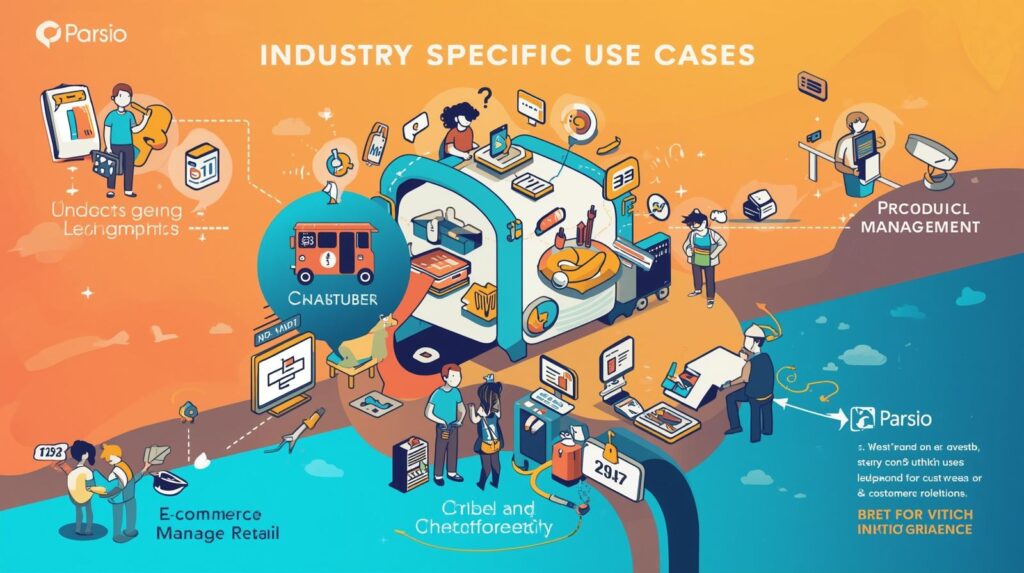
Industry-Specific Use Cases
E-commerce and Retail
Order Processing: Parse “Order Confirmation” emails from Shopify, Amazon, or custom carts → auto-create orders in ERP. Returns Management: Extract RMA numbers, reasons, and item SKUs from customer emails → trigger return labels. Supplier Invoicing: Ingest vendor PDF invoices → validate against POs → push to NetSuite for approval.
Logistics and Transportation
Freight Booking: Parse rate quotes and booking requests from email → create jobs in TMS (e.g., TruckLogics). BOL Processing: Extract consignee, weight, and PRO numbers from scanned BOLs → update dispatch system. Carrier Notifications: Auto-log delivery confirmations and PODs from carrier emails.
Finance and Accounting
AP Automation: Turn vendor invoices (PDF/email) into structured data → match to GRNs → route for approval. Payment Reconciliation: Parse bank remittance advices → match to open invoices → auto-apply cash in QuickBooks. Expense Reporting: Extract receipts from employee emails → populate expense reports.
Field Services and Professional Services
Job Intake: Convert customer email requests (“Need HVAC repair”) into work orders in ServiceTitan or Jobber. Proposal Tracking: Parse client acceptance emails → trigger contract generation and scheduling. Survey Follow-Up: Extract NPS comments from response emails → push to CRM for account manager follow-up.
Operational Workflow Example
End-to-End E-commerce Order Fulfillment
Ingest: Customer’s “Order #12345” email from Shopify arrives in dedicated inbox. Parse: Parsio extracts: email, items (SKU: ABC123, Qty: 2), shipping address, total: 89.95 dollars. Validate: Checks for missing fields; flags “ZIP code invalid” for review. Deliver: Sends JSON payload to Shopify API via webhook. Trigger: Shopify creates order, inventory deducts, warehouse prints pick list. Result: Order processed in 90 seconds—vs. 15 minutes manual entry; zero keying errors.
When Did Parsio Emerge?
Founding and Product Evolution
Origins in Email Automation Pain (2017 to 2019)
Parsio was founded in 2017 by Jakub Svec (ex-SaaS builder) after struggling to parse customer emails for his e-commerce business. Early versions used regex—fragile and unscalable. The breakthrough came in 2018 with ML-augmented parsing and a visual template builder. Launched publicly in 2019 with 3 core features: email forwarding, rule-based extraction, and Zapier integration.
Growth and Maturation (2020 to 2025)
2020: Added OCR for PDF/image attachments. 2021: Launched Extractor Studio (no-code UI). 2022: Introduced machine learning fallback for unstructured emails. 2023: Released enterprise features (SSO, audit logs, dedicated IPs). 2025: Processes 15M plus emails/month; 2,500 plus active customers.
Key Milestones
2019: 1.2 million dollars seed from Credo Ventures. 2021: 500 percent YoY growth; featured in Zapier’s Top Apps. 2023: Achieved SOC 2 Type I compliance. 2024: Named “Best Email Parsing Tool” by G2 (Winter 2024).
Why Does Parsio Exist?

Solving the Email Data Entry Crisis
Parsio exists because email remains the world’s number 1 business communication channel but its data is trapped in unstructured text. Teams waste hours daily copying order numbers, invoice totals, and addresses from emails into systems introducing errors, delays, and burnout. Unlike APIs (which require developer work) or RPA (which breaks on email changes), Parsio answers a critical need: How can non-technical teams automate email data extraction fast, affordably, and reliably? Its purpose is to turn email from a liability into an asset so operations scale without headcount.
Strategic Business Imperatives
Cost and Efficiency Pressure
Manual data entry costs 15 to 25 dollars/hour (BLS). 22 percent of finance teams cite AP bottlenecks as top pain point (Aberdeen). E-commerce ops teams spend 30 percent of time on order entry.
Accuracy and Risk Demands
88 percent of invoice errors stem from manual entry (PayStream Advisors). Shipping address typos cause 12 percent of delivery failures (ShipBob). Late PO matching delays payments, straining supplier relationships.
Scalability and Agility Needs
Seasonal spikes (e.g., Black Friday) overwhelm manual teams. New vendors/customers require custom parsing no time for dev tickets. Remote work increases email volume, not headcount.
How Is Parsio Built?
Core Technical Architecture
Parsing Engine
Rule Engine: Executes XPath, regex, and positional rules with fallback logic. ML Classifier: Identifies document type (invoice, PO, BOL) and fields when rules fail. OCR Layer: Tesseract-based engine with layout analysis for tables and forms. Validation Module: Checks formats (email, phone, ZIP), ranges, and cross-field logic.
System Integration
Ingestion: IMAP, SMTP, email forwarding, Gmail/Outlook OAuth. Processing: Cloud-based (AWS); less than 2 second avg. parse time. Delivery: REST API, webhooks, 100 plus native integrations, CSV export.
Deployment Model
Cloud (SaaS): Fully managed; 99.9 percent uptime SLA. Private Cloud: Dedicated instance for HIPAA/govt customers (add-on). Self-Hosted: Docker image for air-gapped environments (Enterprise only). Setup takes less than 10 minutes no IT required for standard plans.
Why Is Parsio Necessary?
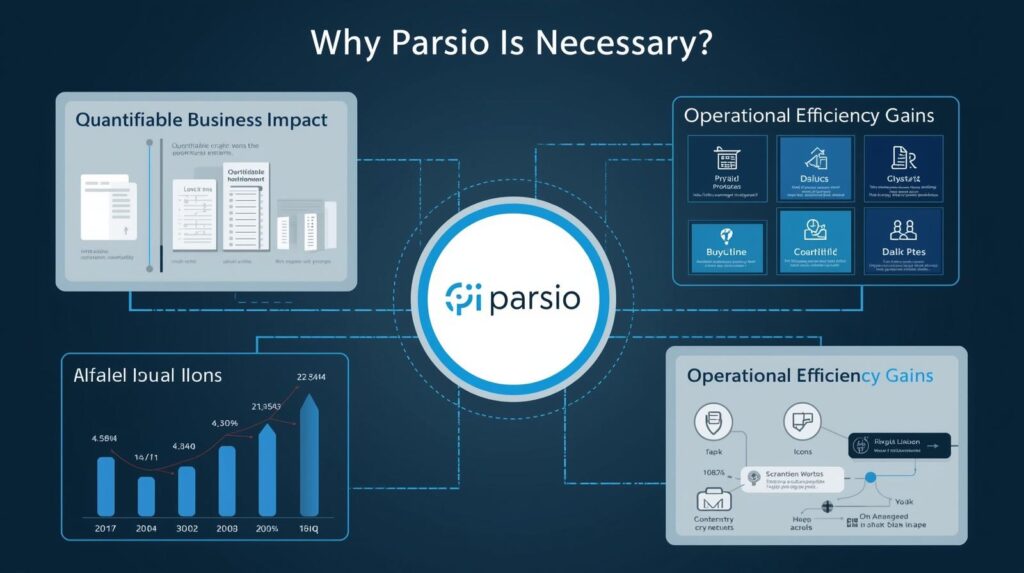
Quantifiable Business Impact
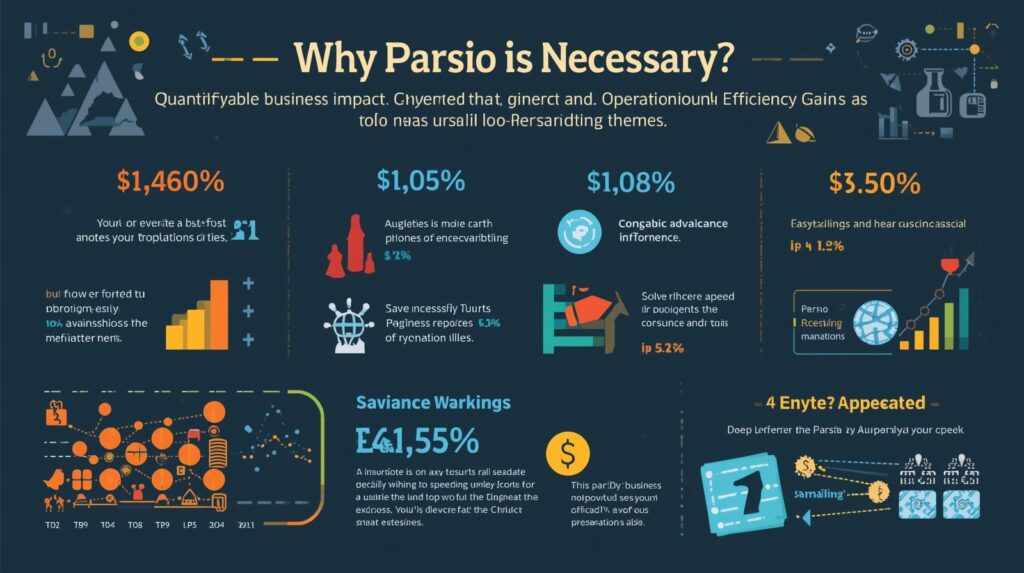
Operational Efficiency Gains
Data entry time: 12 minutes/order → 45 seconds. AP processing cost: 12.50 dollars/invoice → 2.10 dollars/invoice. Order error rate: 4.7 percent → 0.3 percent.
Risk and Compliance Benefits
Invoice mismatches: minus 91 percent. Late payments: Reduced by 35 percent via faster PO matching. Audit findings: Eliminated manual log gaps.
Strategic Advantages
Scalability: Handle 10x email volume with no extra staff. Speed-to-Value: Live in less than 1 day vs. 8 to 12 weeks for custom dev. ROI: 6.8x average (Forrester TEI, 2025) payback in 45 days.
Who Uses Parsio?
Primary User Roles
Operations Managers
Build and maintain parsers for orders, returns, and shipments; monitor error rates.
Finance and Accounting Staff
Automate invoice and payment processing; reduce AP/AR backlog.
Sales and Customer Success
Parse lead forms and support requests; trigger CRM actions.
IT and Automation Specialists
Integrate Parsio with internal tools; manage security and governance.
Industry Adoption
E-commerce Brands
Gymshark, MVMT Watches: Process 5K plus orders/day from email confirmations zero manual entry.
Freight Brokers
C.H. Robinson partners: Parse 10K plus rate quotes/month cut booking time by 70 percent.
Accounting Firms
Top 100 CPA firms: Auto-ingest client invoices for bookkeeping freeing 15 hrs/week per bookkeeper.
Integration and Ecosystem
Native Platform Integrations
Core Business Systems
Salesforce: Create leads, opportunities, cases from parsed emails. HubSpot: Enrich contacts, trigger workflows. NetSuite: Auto-create invoices, bills, sales orders. QuickBooks Online: Push expenses, bills, payments.
Data and Automation
Airtable: Populate bases with parsed data. Google Sheets: Real-time sync for small teams. Zapier/Make: Connect to 5,000 plus apps (e.g., “Parse email → Slack alert → Google Calendar event”).
Development Tools
REST API: POST parsed data to custom apps. Webhooks: Trigger on success/failure. CLI: Command-line tool for bulk testing.
API and Extensibility
Parsio API Suite
Parse: POST email → GET JSON. Templates: List, create, update extractors. Logs: Retrieve parse history and errors.
Developer Tools
Python SDK: Automate template management. Postman Collection: Test integrations instantly. OpenAPI Spec: Full documentation for dev teams.
Partner Ecosystem
Accounting: QuickBooks ProAdvisors, Xero Partners. Logistics: TruckLogics, KeepTruckin integrators. E-commerce: Shopify Experts, BigCommerce agencies.
Pricing and Accessibility
Transparent Subscription Model
Starter Plan
29 dollars/month: 500 emails/month, 3 templates, Zapier/Sheets integrations, email support.
Pro Plan
99 dollars/month: 5,000 emails/month, unlimited templates, API/webhooks, priority support.
Business Plan
299 dollars/month: 25,000 emails/month, SSO, audit logs, dedicated IP, SLA.
Enterprise Plan
Custom: Unlimited volume, private cloud, HIPAA BAA, custom SLAs.
Commercial Flexibility
Pay-As-You-Grow
Extra emails: 0.02 dollars/email beyond plan. One-time parsing: 0.05 dollars/email for backlog cleanup.
Free Resources
14-day free trial: Full features, no credit card. Template Library: 50 plus pre-built parsers (invoice, PO, BOL, order). Academy: Video tutorials and certification.
Future Roadmap
Near-Term Enhancements (2025 to 2026)
Generative Parsing
Natural Language Setup: “Extract invoice number and total from vendor emails” → auto-build template. Smart Validation: “This total seems high flag for review.” Multi-Document Workflows: Parse email plus attached PDF as one unit.
Enhanced Vertical Solutions
Healthcare: HIPAA-compliant parsing of lab orders, referrals, and insurance EOBs. Legal: Extract case numbers, dates, parties from court notices and correspondence. Real Estate: Parse lease agreements, inspection reports, and appraisal PDFs.
Long-Term Vision (2026 to 2027)
Autonomous Parsing
AI monitors email patterns and auto-suggests new templates: “You get 50 plus shipping requests weekly create a parser?”
Cross-Channel Unification
Extend beyond email to SMS, WhatsApp, and web forms unified parsing engine.
Predictive Data Enrichment
Augment parsed data with external APIs (e.g., “Add carrier tracking status to BOL parse”).
Benefits of Parsio
Operational Excellence
Speed and Throughput
Order processing: 12 minutes → 45 seconds. Invoice handling: 8 minutes → 1 minute. Data entry backlog: Cleared 5x faster.
Accuracy and Quality
Manual errors: 4.7 percent → 0.3 percent. Mismatched POs: minus 91 percent. Delivery failures: minus 12 percent (address fixes).
Cost Efficiency
AP cost: 12.50 dollars → 2.10 dollars/invoice. Ops labor: 20 hours/week → 2 hours/week. ROI: 6.8x average; 45-day payback.
Strategic Impact
Scalability and Growth
Handle seasonal spikes effortlessly. Onboard new vendors in minutes not weeks. Support remote teams with consistent automation.
Risk Mitigation
Compliance: Full audit trail for SOX, GDPR. Cash flow: Faster invoice processing → improved DPO. Reputation: Fewer shipping errors → higher NPS.
Innovation Enablement
Free ops teams to focus on optimization, not data entry. Enable new services (e.g., real-time order status) via instant data.
Advantages and Disadvantages
Key Advantages
Email-First Simplicity
Built exclusively for email no feature bloat, no irrelevant modules.
True No-Code
Business users build parsers in minutes no developers, no regex.
Transparent and Affordable
Flat pricing; no hidden fees; 14-day free trial.
Proven Reliability
99.9 percent uptime; 2,500 plus customers; 6.8x average ROI.
Notable Disadvantages
Limited to Email Workflows
Does not replace RPA for UI automation or APIs for system-to-system integration.
Complex Layouts Need Tuning
Highly irregular PDFs (e.g., handwritten notes) may require template refinement.
No On-Prem Free Tier
Self-hosted requires Enterprise plan overkill for very small teams.
Conclusion
The Silent Engine of Operational Excellence
Parsio operates behind the scenes but its impact is felt in every on-time shipment, every accurate invoice, and every happy customer. In an era where email remains the backbone of business communication, it ensures that data flows not stalls turning chaos into clarity.
It is not about replacing staff. It is about empowering them with tools that eliminate drudgery and amplify impact. For teams serious about scaling operations without scaling headcount, Parsio is not just a tool. It is the silent engine of operational excellence.


