
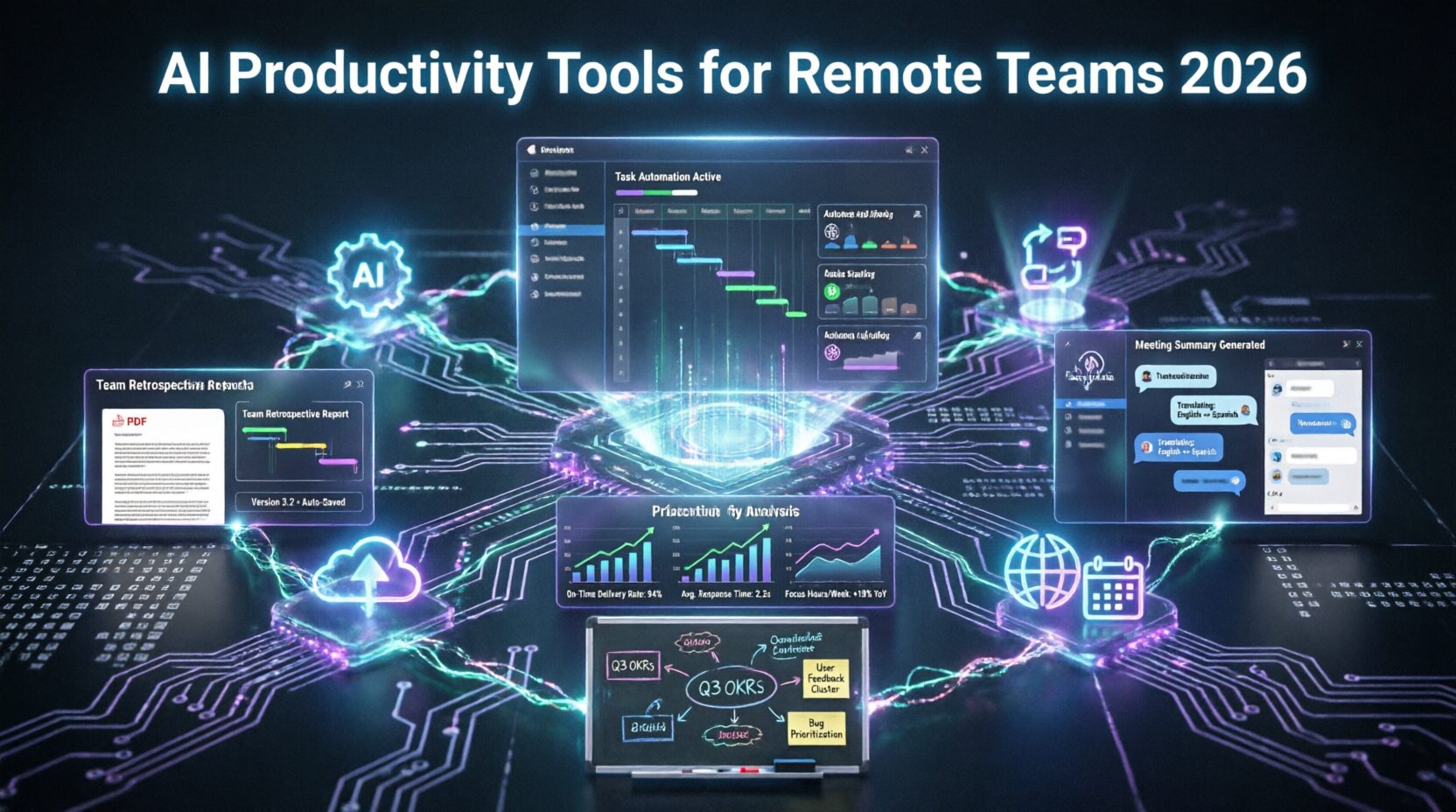
The landscape of remote work has undergone a massive transformation, and identifying the Best AI Productivity Tools for Remote Teams 2026 has become the ultimate competitive advantage for distributed organizations. In an era where talent is global and offices are virtual, relying on traditional project management and communication tools is no longer sufficient to maintain productivity, collaboration, and team cohesion. However, with hundreds of AI-powered platforms flooding the market, separating the gimmicks from the genuine productivity-generators can be overwhelming. Whether you are managing a fully distributed startup, leading a hybrid enterprise team, or coordinating freelance contractors across time zones, understanding which platforms constitute the Best AI Productivity Tools for Remote Teams 2026 is essential for scaling your operations and maintaining a competitive edge.
This comprehensive guide reveals the 7 critical categories and top solutions when evaluating the Best AI Productivity Tools for Remote Teams 2026. By breaking down the most effective AI collaboration software, remote work automation platforms, and intelligent project management systems, this article will provide you with a clear, actionable roadmap to building a highly efficient, AI-augmented remote workforce. By the end, you will know exactly how to leverage these tools to eliminate communication silos, automate repetitive tasks, and foster a culture of asynchronous productivity.
1. The Evolution of Remote Work: Why AI Productivity Tools Are Essential
To understand why the Best AI Productivity Tools for Remote Teams 2026 are no longer optional, we must look at the shifting dynamics of the modern workforce. According to Gartner’s Future of Work Research, by 2026, over 60% of the global workforce will be operating in hybrid or fully remote capacities. The traditional 9-to-5 office model is rapidly being replaced by asynchronous, outcome-based work structures that span multiple time zones and cultures.
When you deploy the Best AI Productivity Tools for Remote Teams 2026, you effectively create a “digital headquarters” that never sleeps. AI-powered tools can bridge the gap between distributed team members, automate the coordination of complex workflows, and provide real-time insights into project health without requiring constant status meetings. Furthermore, mastering the difference between AI agents vs AI tools is crucial here; while standard tools require your team to manually input data and trigger actions, emerging autonomous AI agents can proactively manage schedules, draft project updates, and even resolve minor technical issues while your team focuses on high-value creative work. For a deeper understanding of how to instruct these AI systems to align with your team’s workflow, explore our comprehensive guide on How to Write AI Prompts.
2. AI-Powered Project Management: The Backbone of Remote Collaboration
When evaluating the Best AI Productivity Tools for Remote Teams 2026, the core engine of any remote operation is the project management platform. Traditional tools like Trello or Asana have evolved into intelligent command centers that utilize machine learning to predict bottlenecks, allocate resources, and automate task assignments.
Essential Features of AI-Powered Project Management:
- Predictive Resource Allocation: The AI analyzes historical team performance data to predict which team members are best suited for specific tasks, preventing burnout and ensuring optimal skill utilization.
- Automated Status Updates: Instead of nagging team members for updates, the AI scans activity across integrated tools (GitHub, Slack, Google Docs) to automatically generate progress reports and flag potential delays before they become critical.
- Smart Prioritization: The system dynamically re-ranks tasks based on changing deadlines, dependencies, and strategic goals, ensuring that remote teams are always working on the highest-impact activities.
- Sentiment Analysis: Advanced platforms can analyze communication patterns to detect team morale issues or burnout risks, alerting managers to intervene before turnover occurs.
By integrating these AI-powered project management tools, you transform your remote team from a collection of individuals into a synchronized, high-performance unit. To see how these automated workflows integrate into broader enterprise strategies, review our detailed breakdown of AI Solutions for Business.
3. Intelligent Communication Platforms: Breaking Down Remote Silos
Communication is the lifeblood of remote teams, but it is also the source of greatest friction. Endless Slack threads, missed Zoom calls, and lost emails can cripple productivity. The Best AI Productivity Tools for Remote Teams 2026 in the communication space go far beyond simple messaging; they utilize Natural Language Processing (NLP) to organize, summarize, and prioritize information.
Capabilities of Intelligent Communication Platforms:
- AI Meeting Summaries: Tools that join your Zoom or Teams calls, transcribe the audio, extract action items, and automatically email the summary to all participants, eliminating the need for manual note-taking.
- Smart Inbox Triage: AI that reads your team’s emails and Slack messages, categorizing them by urgency and context, and drafting polite responses for routine inquiries, allowing team members to focus on deep work.
- Asynchronous Video Updates: Platforms that use AI to transcribe and summarize Loom or video updates, making it easy for team members in different time zones to catch up without watching hours of footage.
- Context-Aware Notifications: The AI learns your team’s work patterns and suppresses non-urgent notifications during deep work blocks, ensuring that “always-on” culture doesn’t lead to burnout.
When selecting intelligent communication platforms, look for tools that integrate seamlessly with your existing tech stack and offer robust API capabilities for custom automation. For technical teams building these custom communication pipelines, our guide on AI Coding Prompts is an essential resource.
4. Automated Documentation and Knowledge Management
One of the biggest challenges for remote teams is maintaining a single source of truth. When everyone works from different locations, knowledge silos form rapidly, leading to duplicated work and confusion. The Best AI Productivity Tools for Remote Teams 2026 include sophisticated documentation and knowledge management systems that utilize AI to organize, retrieve, and generate content.
How AI Transforms Knowledge Management:
- Automated Wiki Generation: AI tools that scan your team’s Slack conversations, meeting transcripts, and project docs to automatically generate and update internal wiki pages, ensuring that institutional knowledge is never lost.
- Semantic Search: Instead of keyword matching, AI-powered search understands the intent behind a query. A team member can ask “How do we onboard a new client?” and the AI will retrieve relevant SOPs, past meeting notes, and template documents, even if the exact phrase isn’t used.
- Real-Time Translation: For global remote teams, AI translation tools break down language barriers, allowing team members to collaborate seamlessly in their native languages while maintaining a unified documentation standard.
- Content Gap Analysis: The AI analyzes your knowledge base to identify missing information or outdated procedures, prompting subject matter experts to update critical documentation before it becomes a bottleneck.
By leveraging automated documentation tools, you ensure that your remote team operates with the same level of institutional memory as a co-located office. To optimize the search and retrieval of these knowledge assets across your organization, many companies leverage platforms like Elastic AI-powered search.
5. AI-Driven Time Tracking and Productivity Analytics
Managing a remote team requires a shift from monitoring hours to measuring outcomes. However, understanding where time is actually spent is crucial for identifying inefficiencies and preventing burnout. The Best AI Productivity Tools for Remote Teams 2026 in this category use passive data collection and machine learning to provide deep insights into team productivity without invasive surveillance.
Features of AI-Driven Productivity Analytics:
- Focus Time Analysis: The AI analyzes calendar patterns and app usage to identify when team members are most productive, suggesting optimal times for deep work and blocking out unnecessary meetings.
- Burnout Prediction: By monitoring work hours, communication frequency, and sentiment in messages, the AI can flag team members who are at risk of burnout, allowing managers to intervene with support or time off.
- Meeting Cost Calculator: AI tools that analyze the attendees and duration of meetings to calculate the total “cost” in salary hours, encouraging teams to be more selective about who needs to attend which meetings.
- Workflow Bottleneck Detection: The system identifies where tasks tend to get stuck in your workflow (e.g., waiting for design approval), allowing you to streamline processes and remove friction.
When implementing AI-driven productivity analytics, transparency is key. Ensure your team understands that these tools are designed to improve workflow and well-being, not to micromanage or punish. To discover the best platforms for these specialized analytics tasks, check out our guide on the Best AI Prompt Libraries 2026.
6. Virtual Collaboration and Whiteboarding Tools
The loss of the physical whiteboard is often cited as a major drawback of remote work. Spontaneous brainstorming and visual collaboration are harder to replicate virtually. However, the Best AI Productivity Tools for Remote Teams 2026 include advanced virtual collaboration platforms that use AI to enhance creativity and organization.
Capabilities of AI-Enhanced Virtual Whiteboards:
- Handwriting Recognition and Organization: AI that converts messy handwritten notes and sketches on a digital whiteboard into structured text, diagrams, and actionable tasks.
- Idea Clustering: During brainstorming sessions, the AI automatically groups similar ideas, identifies themes, and highlights unique contributions, making it easier to synthesize large volumes of input.
- Real-Time Translation and Transcription: As team members speak or type during a collaboration session, the AI transcribes and translates in real-time, ensuring that language barriers do not stifle creativity.
- Smart Templates: The AI suggests relevant templates and frameworks based on the context of the meeting (e.g., SWOT analysis, user journey mapping), accelerating the ideation process.
By adopting AI-enhanced virtual collaboration tools, you can recreate the magic of the war room in a digital environment, ensuring that distance does not dampen innovation. To ensure your broader document workflows are optimized alongside your collaboration tools, explore our guides on AI Document Analysis Platform and AI compliance document analysis.
7. Implementing AI Productivity Tools: Best Practices for Remote Teams
Selecting the right platforms from the Best AI Productivity Tools for Remote Teams 2026 is only the first step; the true magic happens when you integrate them into a cohesive, automated tech stack. The most successful remote teams use integration platforms (like Zapier or Make) to connect their AI tools, creating seamless workflows that run in the background.
Best Practices for Implementation:
- Start with a Pilot Program: Don’t roll out new AI tools to the entire organization at once. Select a small, tech-savvy team to pilot the tools, gather feedback, and refine the workflows before scaling.
- Invest in Training and Change Management: AI tools are only as effective as the people using them. Provide comprehensive training on how to prompt the AI, interpret the data, and integrate the tools into daily habits.
- Establish Clear Data Governance: Remote teams often handle sensitive client data. Ensure that your AI tools comply with GDPR, SOC 2, and other relevant regulations, and that data is encrypted both in transit and at rest.
- Measure ROI Rigorously: Define clear metrics for success (e.g., time saved on meetings, reduction in email volume, faster project completion times) and track them closely to justify the investment and optimize usage.
To ensure your team or personal freelance network is maximizing the value of these digital health and business tools, explore our comprehensive guide on AI Tools Importance and learn exactly How AI document analysis saves businesses time and money.
Comprehensive Query Coverage
What are the Best AI Productivity Tools for Remote Teams 2026 for small businesses? For small businesses, the Best AI Productivity Tools for Remote Teams 2026 include all-in-one platforms that combine project management, communication, and documentation, such as Notion AI or ClickUp. These solutions offer enterprise-grade features at a scalable price point, allowing small teams to punch above their weight without needing a complex, fragmented tech stack.
How do AI productivity tools improve remote team collaboration? AI productivity tools improve collaboration by breaking down language barriers through real-time translation, organizing chaotic communication threads into actionable insights, and automating the administrative burden of scheduling and note-taking. This allows remote team members to focus on high-value creative work rather than logistical coordination.
Are AI productivity tools secure for remote teams handling sensitive data? Enterprise-grade AI productivity tools are built with security-first architectures. They offer end-to-end encryption, role-based access controls, and compliance with major data privacy regulations like GDPR and HIPAA. However, it is crucial to review the data processing agreements of any tool you adopt to ensure client data is not used to train public AI models.
Can AI tools replace human managers in remote teams? No, AI tools cannot replace human managers; they augment them. AI handles the data analysis, scheduling, and administrative tracking, freeing up human managers to focus on mentorship, strategic planning, and team culture. The human element of empathy and leadership remains irreplaceable in remote team management.
How much does it cost to implement AI productivity tools for a remote team? The cost varies widely depending on the tools selected and team size. Basic AI features in existing platforms may cost an additional $10-$30 per user/month, while dedicated enterprise AI solutions can range from $50-$200 per user/month. However, the ROI in terms of time saved and productivity gains typically justifies the investment within the first quarter.
Conclusion
The Best AI Productivity Tools for Remote Teams 2026 represent a monumental leap forward in organizational efficiency, team cohesion, and operational scalability. By understanding the evolution of remote work, leveraging AI-powered project management for predictive insights, utilizing intelligent communication platforms to break down silos, implementing automated documentation for knowledge retention, deploying AI-driven analytics for productivity optimization, and adopting virtual collaboration tools for innovation, organizations can build a remote workforce that is not just functional, but exceptional.
The transition from traditional, location-based management to AI-augmented, asynchronous leadership requires a shift in mindset. You are no longer just managing people; you are orchestrating a complex digital ecosystem where AI handles the routine, and humans handle the exceptional. By selecting the right tools and implementing them with strategic foresight, you empower your remote team to achieve more with less friction, fostering a culture of deep work and high performance.


